New Kingdom Scaraboid Amulets and a Ring
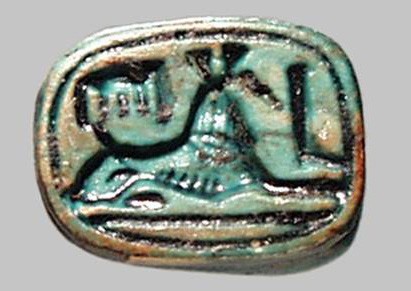
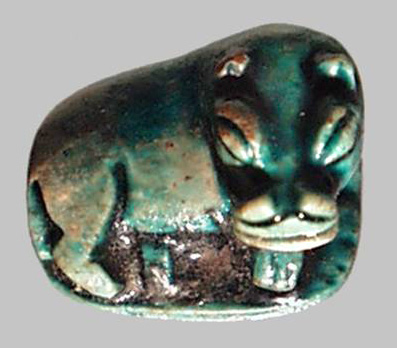
Set on the back side of a hippo amulet ...
Faience, pressed into a mold, New Kingdom
State Hermitage Museum, Petersburg, via GEM
|
"Besides the Seth-animal, the ass and the pig, the oryx antilope,
the gazelle, the crocodile, the hippopotamus and the fish can also
be accounted animals of Seth.", TeVelde, _Seth, God of Confusion_, page 26
The GEM website says this about faience:
"Faience objects have been found from as early as the late Predynastic Period and the Archaic Period (1st and 2nd Dynasties), mainly beads, tiles and small votive objects. Faience objects continued to be produced in the centuries to follow. The majority of the objects found date from the New Kingdom, and especially from the Late Period.
Faience consists for more than 90% of silica, which is found in sand and crushed quartzite. An alkali was then added, such as natron, as well as some lime and a colouring agent, usually crushed copper. The latter gives faience its typical blue-green colour. Water was added to form a paste that could be modelled with the hand, or pushed into a mould. Before the object was fired it could be decorated either with black paint or by carving patterns into it. It was also possible to add inlays of another faience which fired a different colour."
The Museum of Fine Arts at Boston has another example of a hippopotamus amulet with Set (along with Horus) on the back:
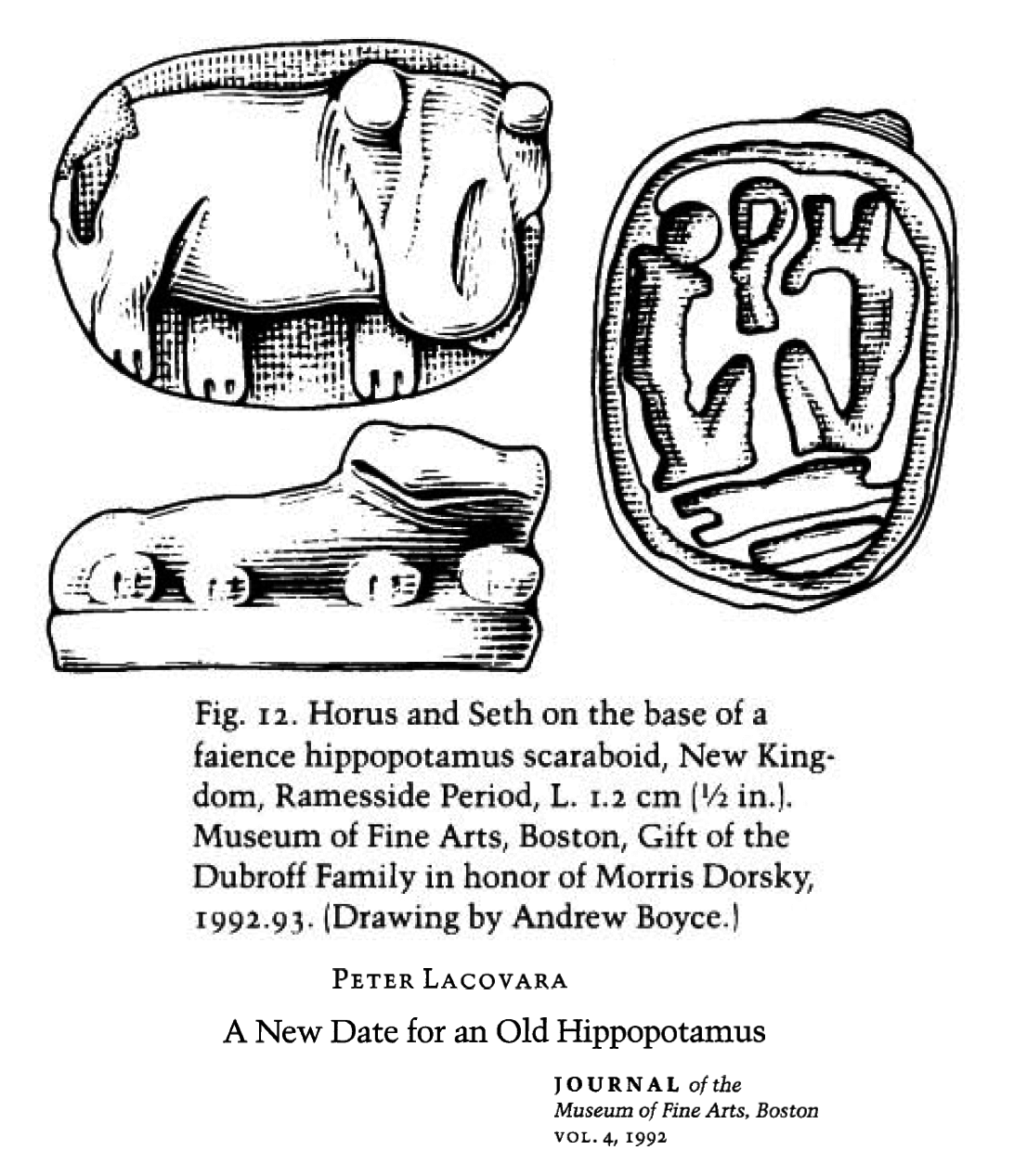
Horus and Seth on the base of a faience hippopotamus scaraboid
New Kingdom, Ramesside Period, L. 1.2cm (1/2 in.).
From "A New Date for an Old Hippopotamus",
by Peter Lacovara, Journal of the Museum of Fine Arts, Boston, Vol.4, 1992
|
Here's a tiny scarab now at the British Museum:
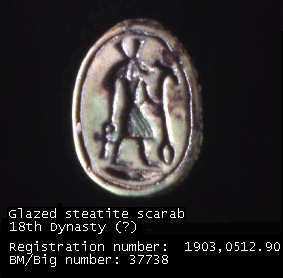
Glazed steatite scarab, 18th Dynasty (?)
Width: 0.55 centimetres, Height: 1.22 centimetres
Registration number: 1903,0512.90
BM/Big number: 37738
Museum Description:
"Glazed steatite scarab, elytra marked with double suture, feathered legs, longitudinally pierced, base decorated with
representation of Seth."
W.M. Flinders Petrie illustrates several scarabs found in _HYKSOS AND
ISRAELITE CITIES_, one of which is a definite Set:
|
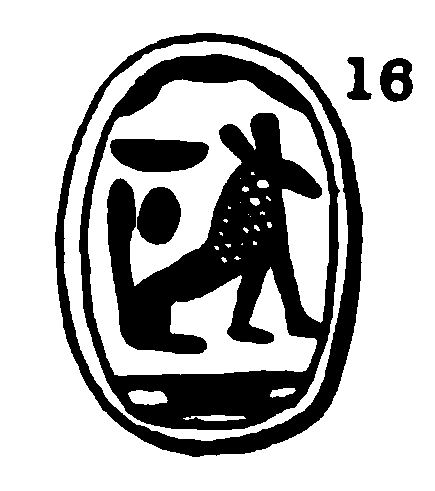
PL. XXXIII. "The greater part of the scarabs
were found loose in the town rubbish, there being
but few in the late cemetery which we excavated."
"14 with the sphinx, 15 with the crio-sphinx,
16 with Set, and 17 with Mentu, are probably all
of Ramessu II."
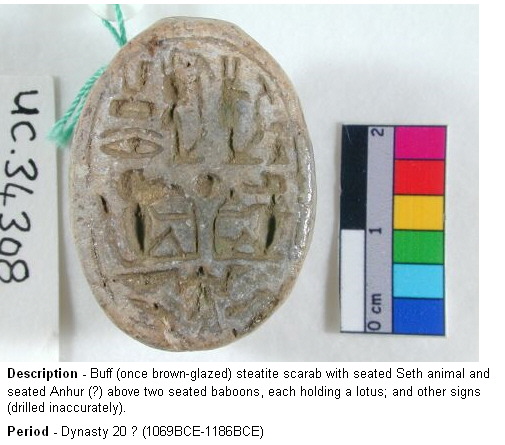
"Buff (once brown-glazed) steatite scarab with seated Seth animal and seated Anhur (?)
above two seated baboons, each holding a lotus; and other signs (drilled inaccurately)."
Period - Dynasty 20 ? (1069BCE-1186BCE)
Height 2.9 cms length 2.1 cm
Petrie Museum, UC34308
|
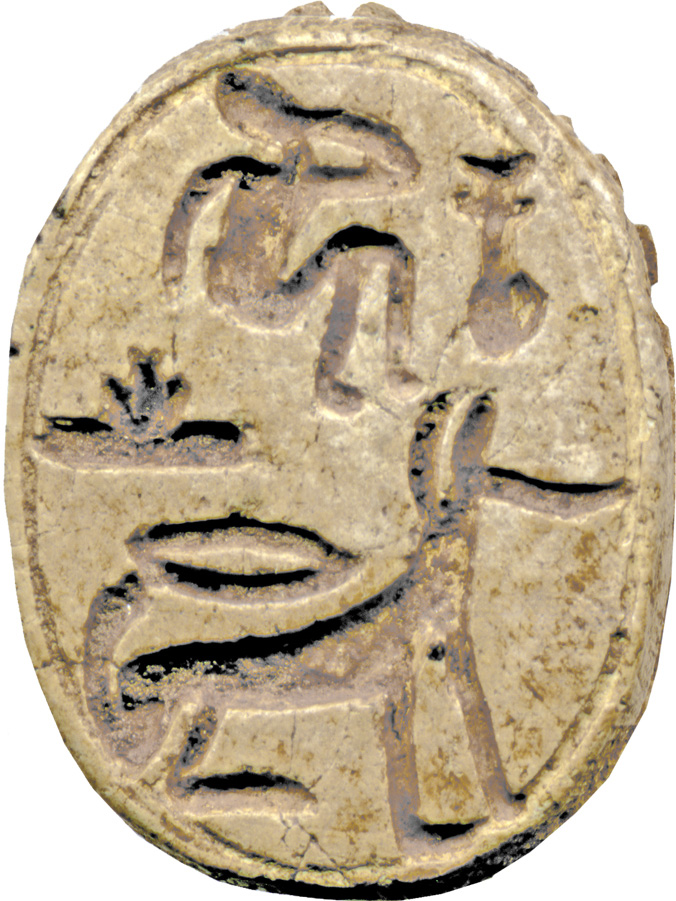
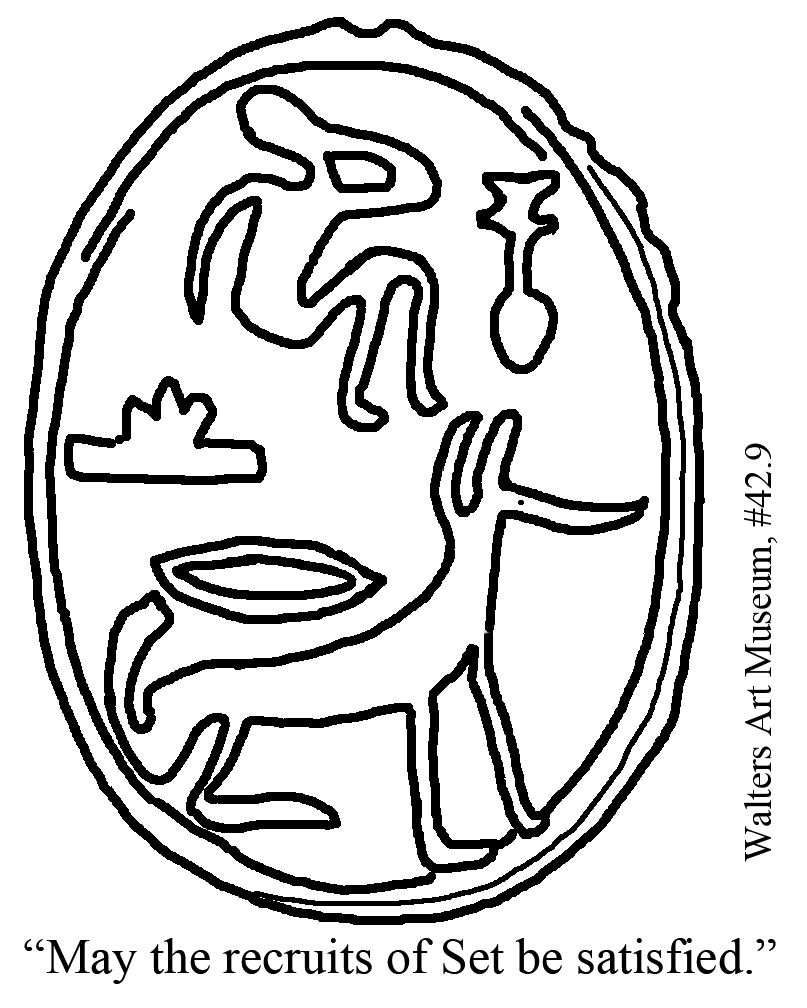
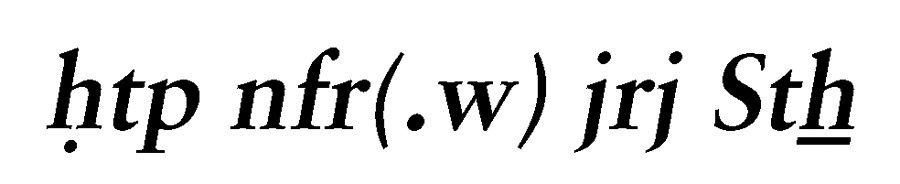
Their website info gave the translation as "May the recruits of Seth be satisfied," and said it was a blessing for soldiers. As we see here the glyph for 'youth',
(the person with their hand to their mouth), the 'nefer' glyph, the 'hotep' glyph and the Set animal (maybe with a uraeus for his tail?), I'm thinking it could be
translated: "May the newbies of Set be satisfied." What ever the 'newbies' were being initiated into, the army, school or the priesthood, it is certainly a
blessing.
The Met museum has a very nice scaraboid hippo amulet:
|
.

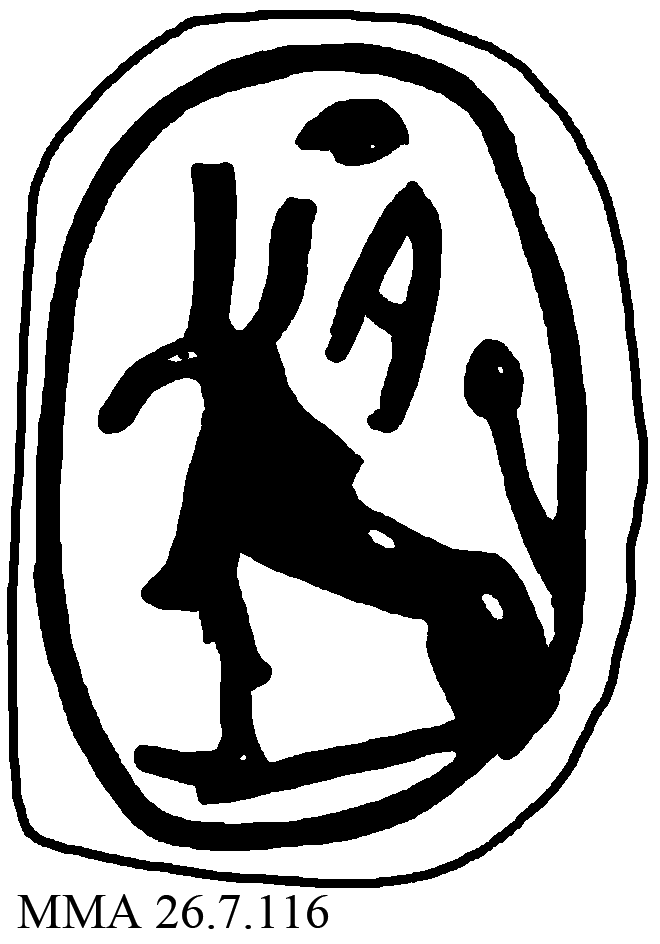 |
My trace from the museum photo of #26.7.116
New Kingdom, Dynasty 18, ca. 1550–1295 B.C.E.
Scarabs from Matmar (Middle Egypt)
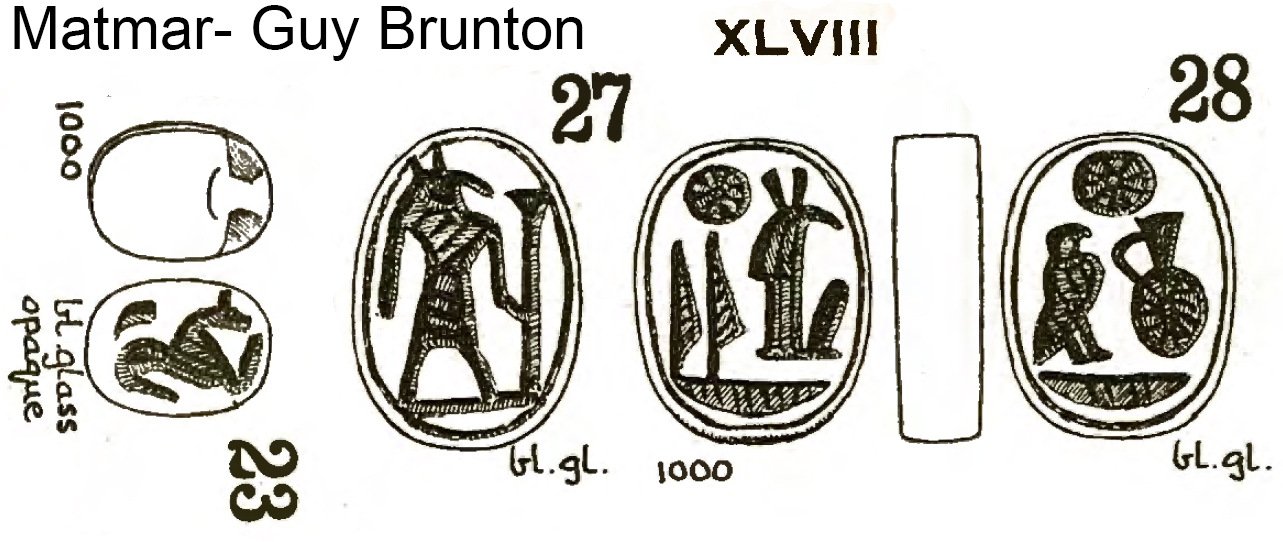
Pl. xlviii, 23. Couchant figure of the god Set. (Munich)
Pl. xlviii, 27. Standing figure of Set with papyrus sceptre. (Cairo 54397)
Also see 28 beside it with an unmistakable Set figure.
|
Guy Brunton describes scarab 28:
"Pl. xlviii, 28. Plaque with Re(-Seti on one side and Re'-khnum-Hor on the other. This seems
to express the unity of the solar gods Re( and Horus with one another and with Set or the king Seti.
Rowe suggests "Perhaps both sides are to be read together as ' United are Horus and Set every day ',
a reference to the reconciliation of the two gods. See ROWE, Scarabs, p. 325." (Cairo 54396.)"
(Matmar: British Museum Expedition to Middle Egypt, by Guy Brunton, (Quaritch Ltd, 1948), page 69)
Ramesses II had built a temple to Set in Matmar, and although it didn't survive, there is enough evidence that it was there.
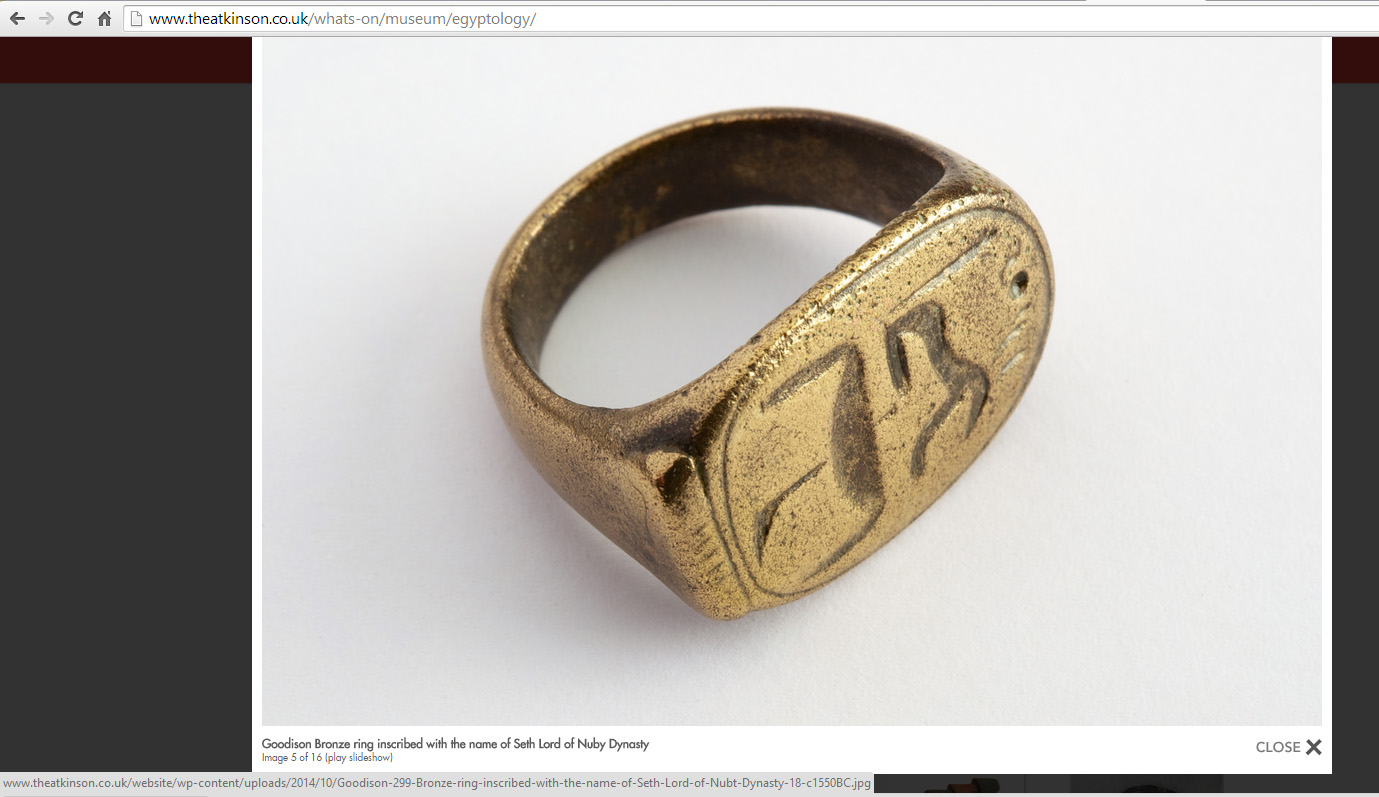
The Atkinson museum has an 18th dynasty ring:
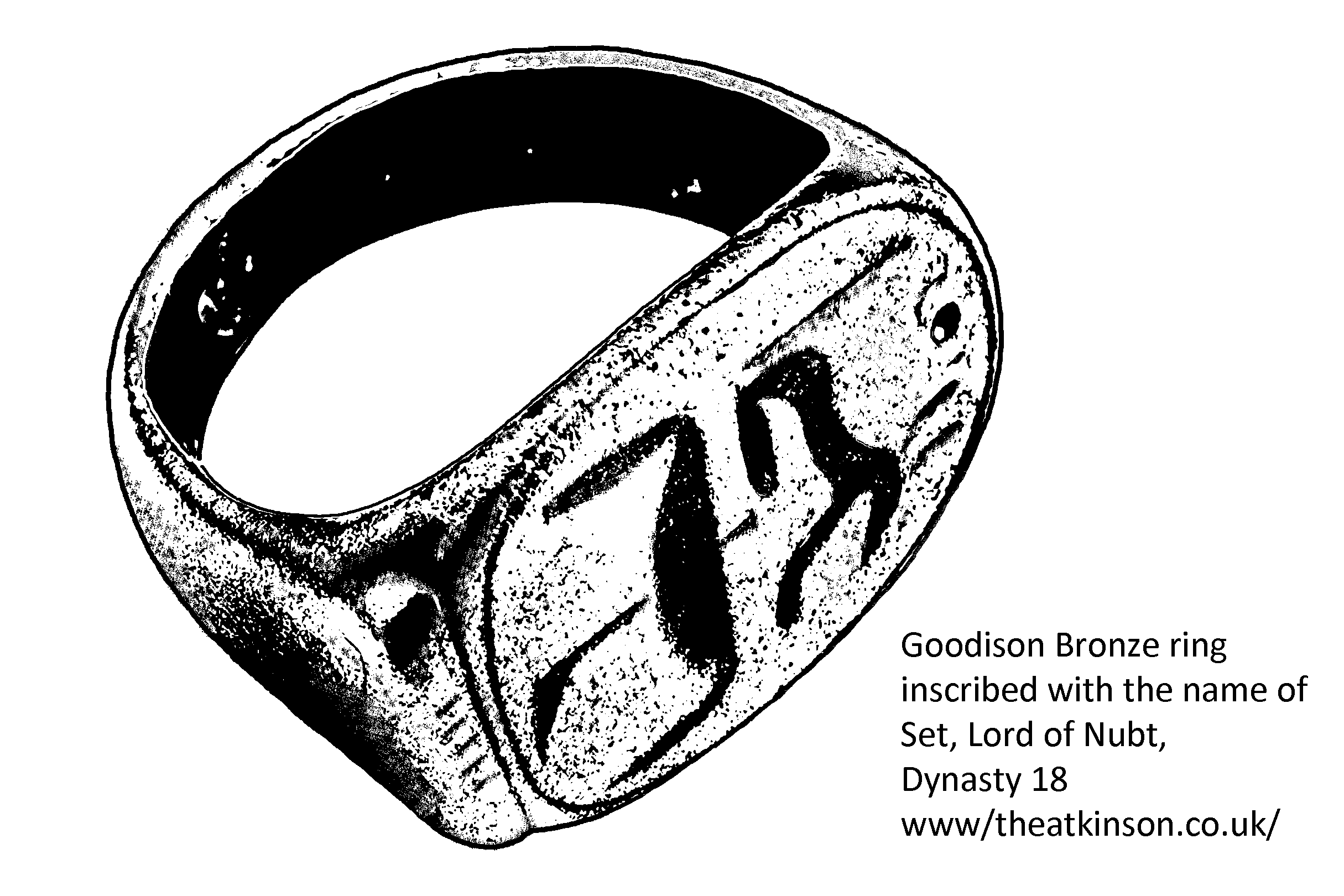
Goodison Bronze ring inscribed with the name of Set, Lord of Nubt, Dynasty 18
(My B/W image created from reference to museum website photo)
|

 My trace from their photo of a small scarab at the Walters Art Museum, #42.9