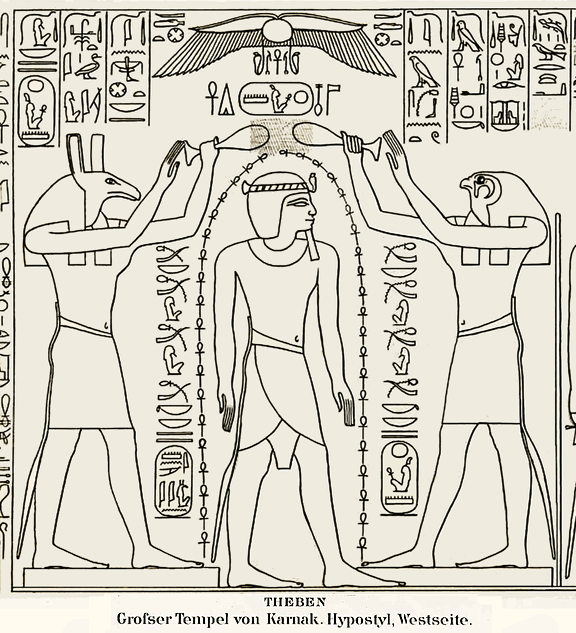
From Denkmäler aus Aegypten und Aethiopien by Lepsius
(This is available in printable line drawing pdf)
From Denkmäler aus Aegypten und Aethiopien by Lepsius
(This is available in printable line drawing pdf)
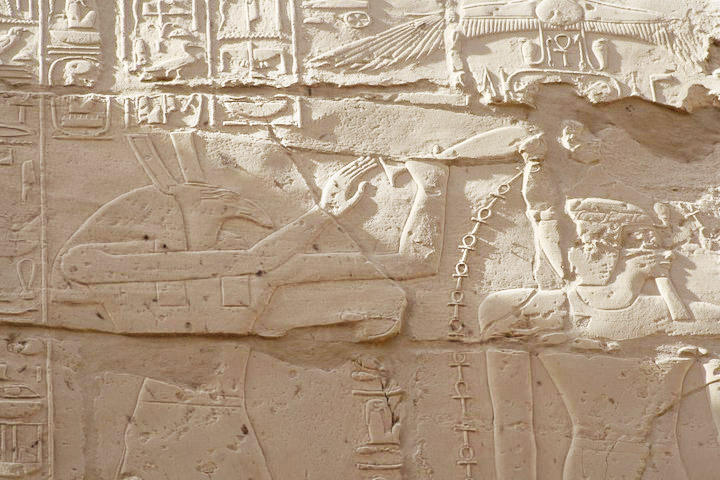
| Seti I has a relief of himself being blessed by Set and Horus, which is at the large Karnak temple. |
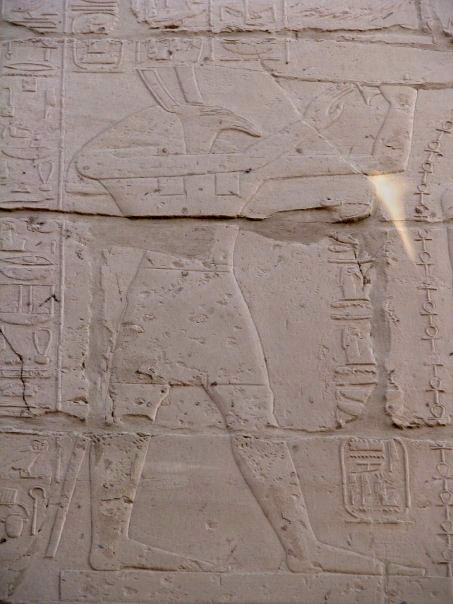
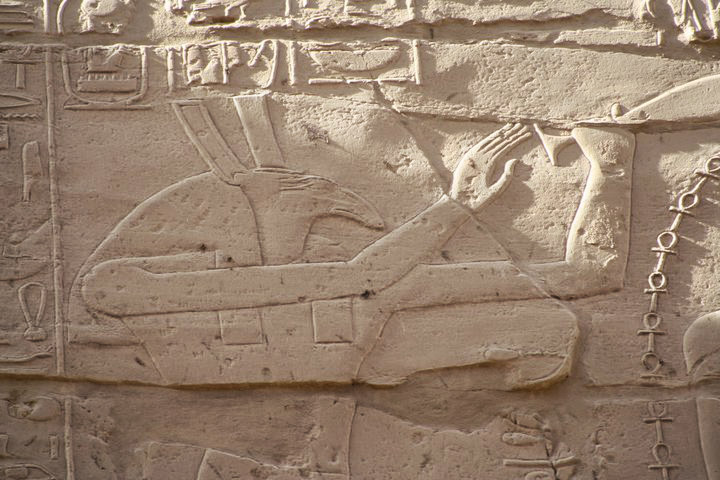
Hans Kontkanen, who visited Karnak in December 2010, has a closer view of Set and this photo above which is even closer.
|
Naydler explains this scene: "In a possible reference to a baptismal ceremony associated with his accession, the king is described as 'the third at his accession.' As a third, he would be between Horus and Seth (or Horus and Thoth), who would be standing on either side of him and would pour baptismal water over him. The position of the king between the dual gods, receiving blessings from both, symbolizes his union of their opposing natures within himself."(pages 305-306) The baptismal water he refers to shows in a much later relief "Horus and Thoth purifying Ptolemy XIII at the temple of Kom Ombo". In both Unas and Ramses III, the deities have their hands at the pharoah's crown. I wondered at this change to Horus and Thoth, rather than Horus and Set, and thought it was due to changing attitudes towards Set. But Wilkinson shows this is not so, for even when Set is not shown, he is still understood to be there:
Giving examples of when 'two' actually represents 'four', "in a classic study of the royal purification ritual, Sir Alan Gardiner showed that the two gods usually depicted performing the act of lustration - Horus and Thoth (ill. 124) - actually represented the four gods of the cardinal points Horus, Seth, Thoth, and Anti who transferred to the king a portion of their power as the divinities of the four quarters of the world. Private representations of funerary purifications (which were symbolically parallel) actually show four priests performing the rite, but the royal depictions of this ritual almost always depict only two of the deities, perhaps for purposes of symmetry and representional balance. Whatever the reason, once again we see two representing four and thereby carrying the connotation of the extended number, though the use of the two deities Horus and Thoth (paralleling the common use of Horus and Seth) may also have connoted the dualism of Upper and Lower Egypt." (from _Symbol and Magic in Egyptian Art_, by Richard H. Wilkinson, page 139)
Here is an Old Kingdom example:
 Unas stands between Horus and Seth during a kingship rite. Reconstruction from relief fragments found at his pyramid temple at Saqqara
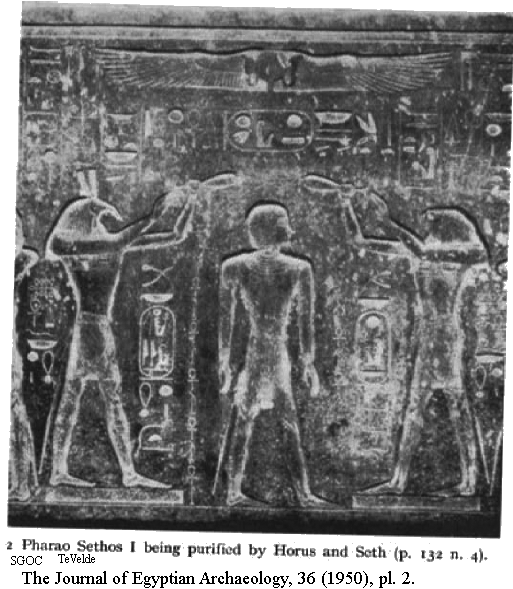 "Pharoa Sethos I being purified by Set and Horus" The Journal of Egyptian Archaeology, 36 (1950), pl. 2.
|
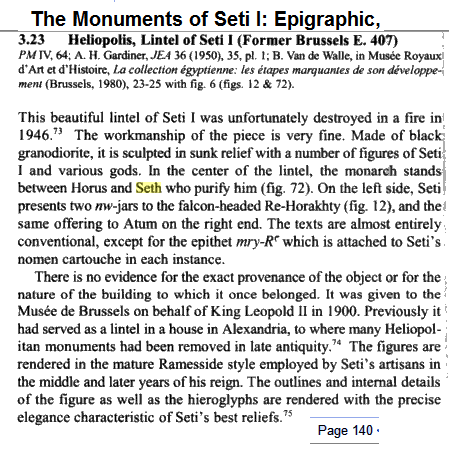
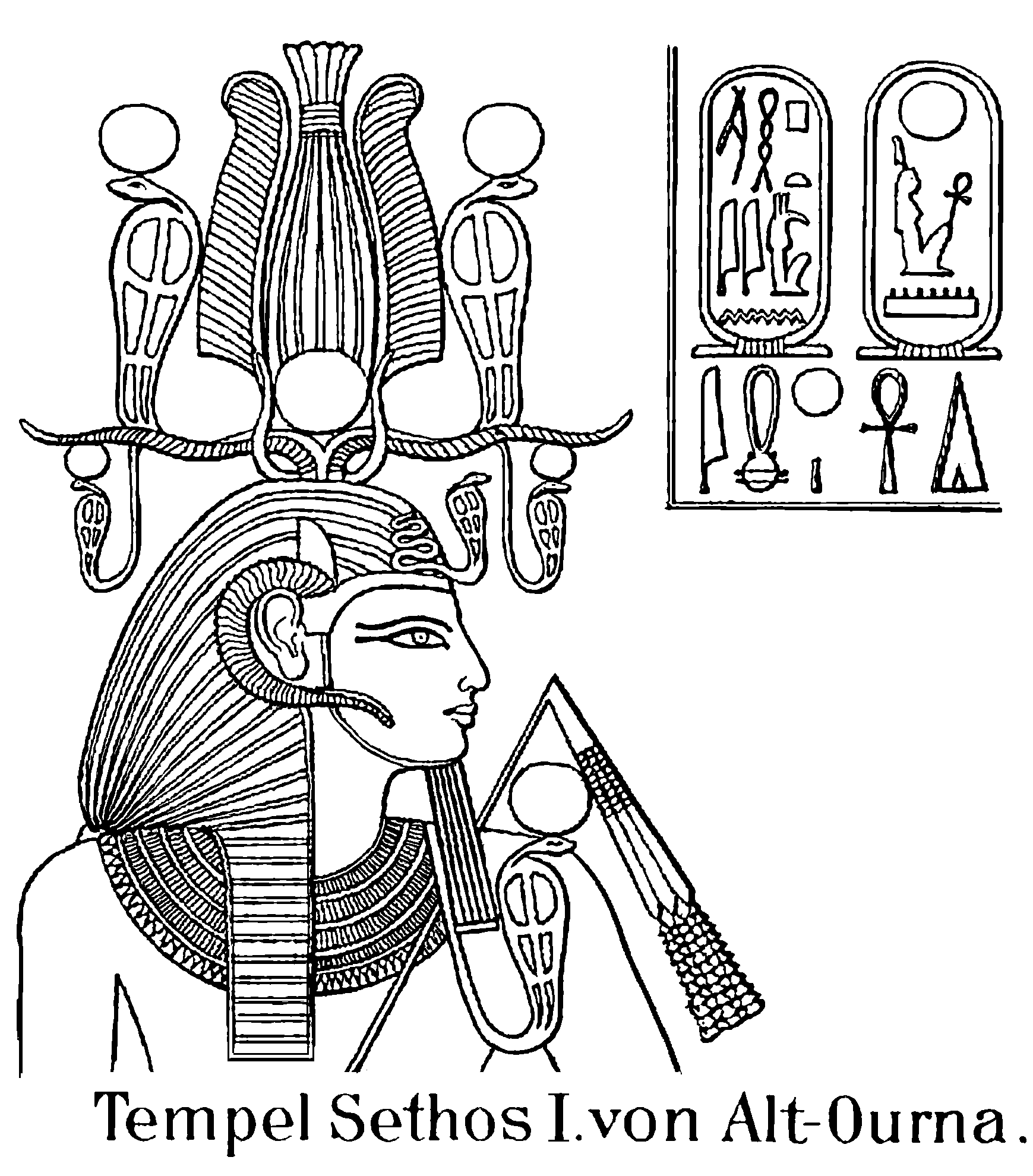
| Brand refers to the 'precise elegance' of Seti I's reliefs. Fortunately the old drawings and photos preserve the memory of them in better shape. Here is an elegant rendering of Seti I at Alt-Ourna: |
|
His cartouches are there beside the portrait. We have seen how a trick was done in their representation, particularly at the Abydos temple. His glyphs are rendered in other creative ways, such as in this ring now at the Met Museum: |
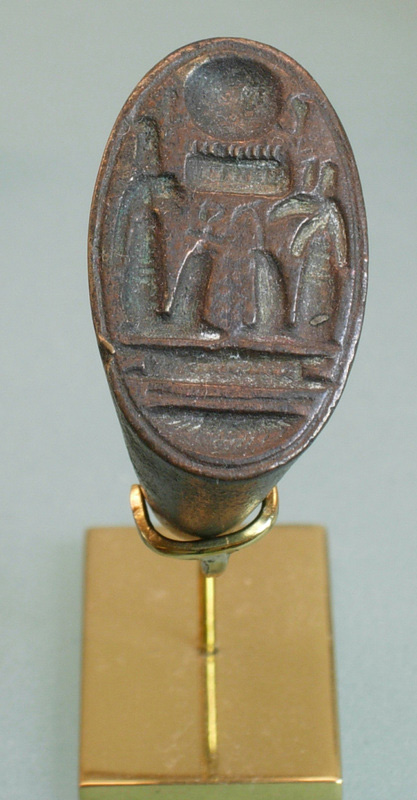 Bronze Ring of Seti I New Kingdom, Ramesside, Dynasty 19–20, ca. 1295–1070 B.C.E. Egypt, Middle Egypt, el-Amarna (Akhetaten); inc. el-Hagg Qandil Rogers Fund, 1959 Accession Number:59.151.2 Photo credit: The Metropolitan Museum |
|
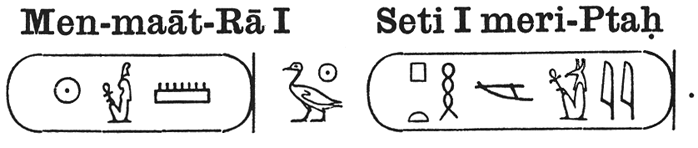
We can see the "Men-Ma'at-Re" thusly: Ra's round glyph is at the top, and the 'men' glyph (meaning 'enduring) is underneath. The goddess Ma'at faces the god Set. Underneath them, there is a 'mer' glyph, representing a canal which is a specially-made channel for water, and the neb 'bowl' glyph at the bottom. Neb meaning 'bowl' or 'lord' is underlining that Seti II contains within him, as he is a channel for them, the forces of Ma'at and Set. The Met museum also houses Seti I's offering table which originally was likely at the temple in Naqada: |
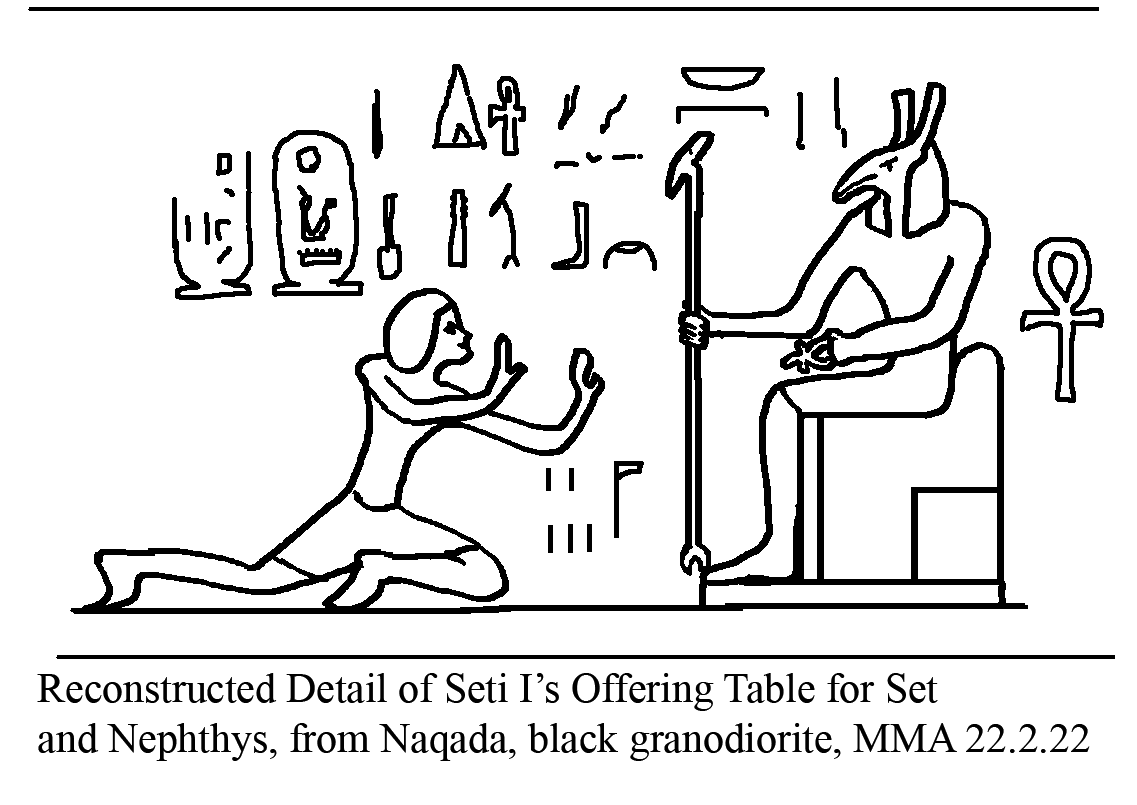
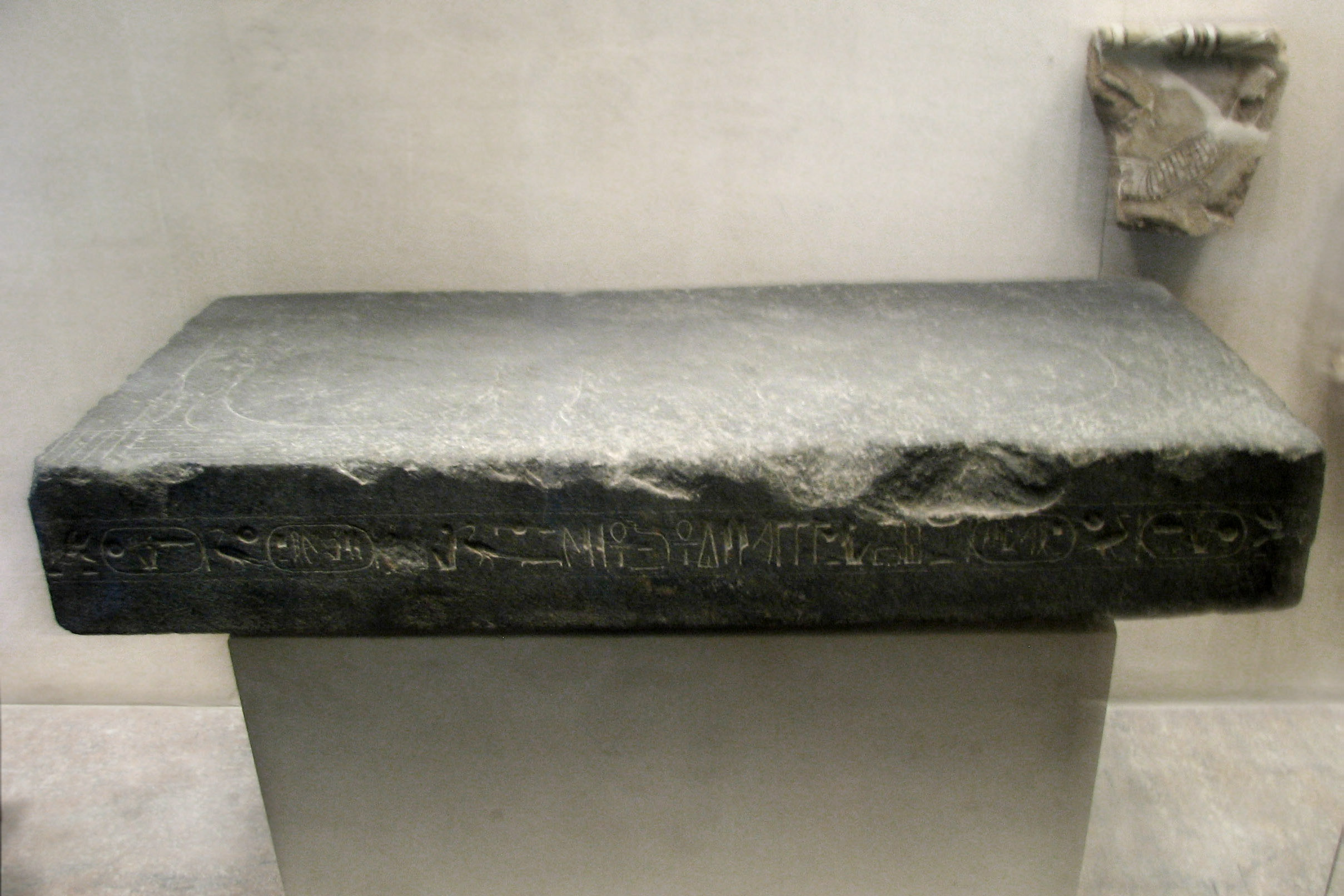 Offering Table of Seti I for Seth and Nephthys New Kingdom, Ramesside, Dynasty 19, reign of Seti I, ca. 1294–1279 B.C.E. Black granite, L. 105 cm (41 5/16 in). w. 53.3 cm (21 in), Thick. 15.8 cm (6 1/4 in) Rogers Fund, 1922, Metropolitan Museum 22.2.22 |
|
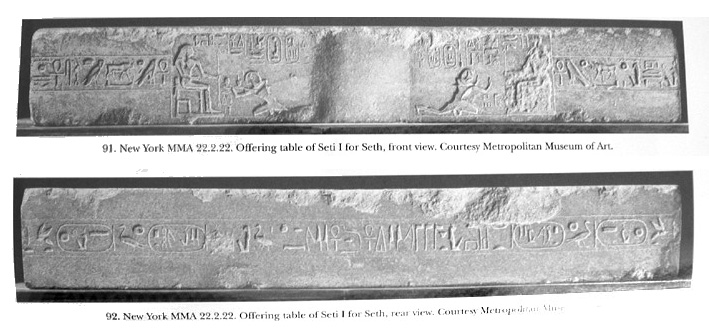
Peter Brand speaks of this offering table in his _Monuments of Seti I_:
"The layout of the decoration is identical to that of the Ny-Carlsberg table
dedicated to Horus, the table top being decorated with two pairs each of
conical and round bread loaves and a pair of jars. On the front side, two
miniature offering scenes flank the concave depression. On the right, Seti
kneels with his legs splayed out and his arms upraised in adoration of Seth,
who sits enthroned on a plinth. The act of the king is labeled "adoring the
god four times.' Seth's figure has been hacked out in antiquity, but its
outline, as well as many internal details, can easily be made out." (page 189)
The front of the table with its damage was to the back when I photographed it. But here is a close up detail of Seti I adoring Set, no doubt acting as High Priest of Set:
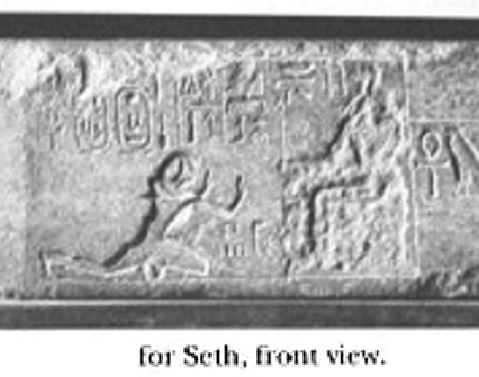 From a photo in Brand's book
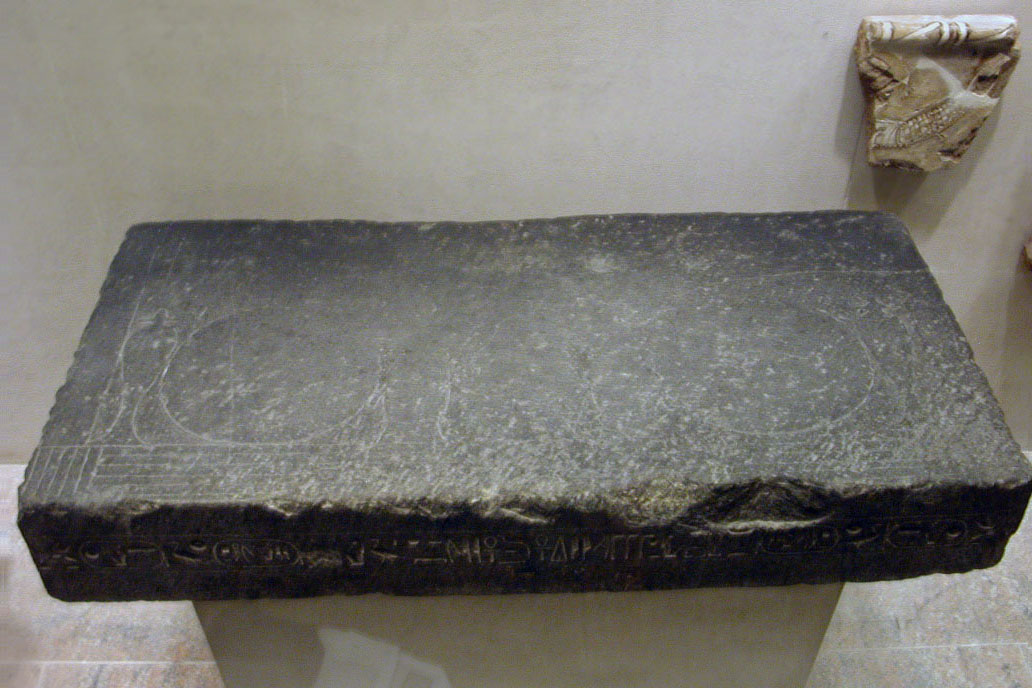 Photo credit Mark Roblee Because Mr. Roblee is taller than I am, his photo shows the top side as well!
|