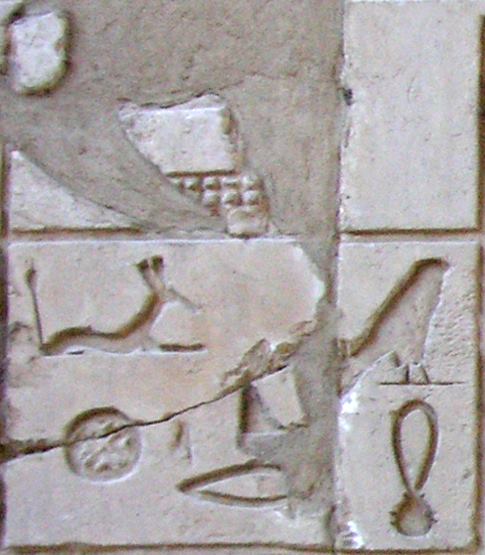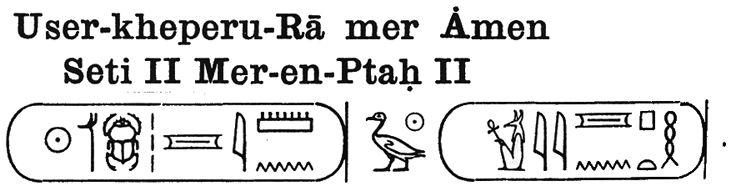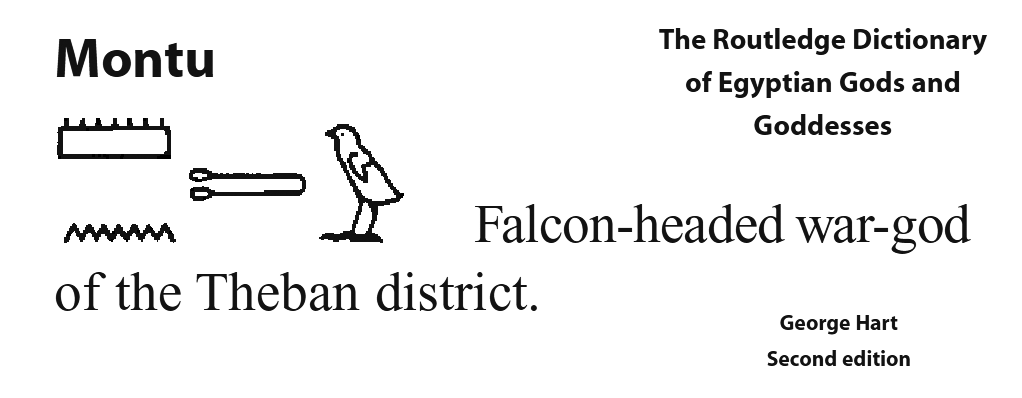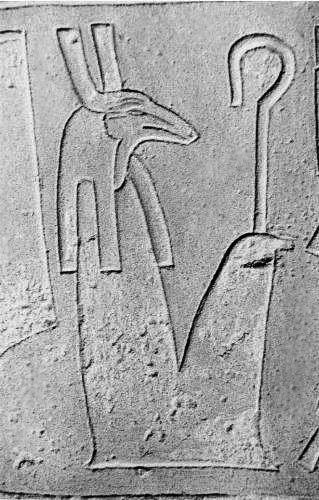
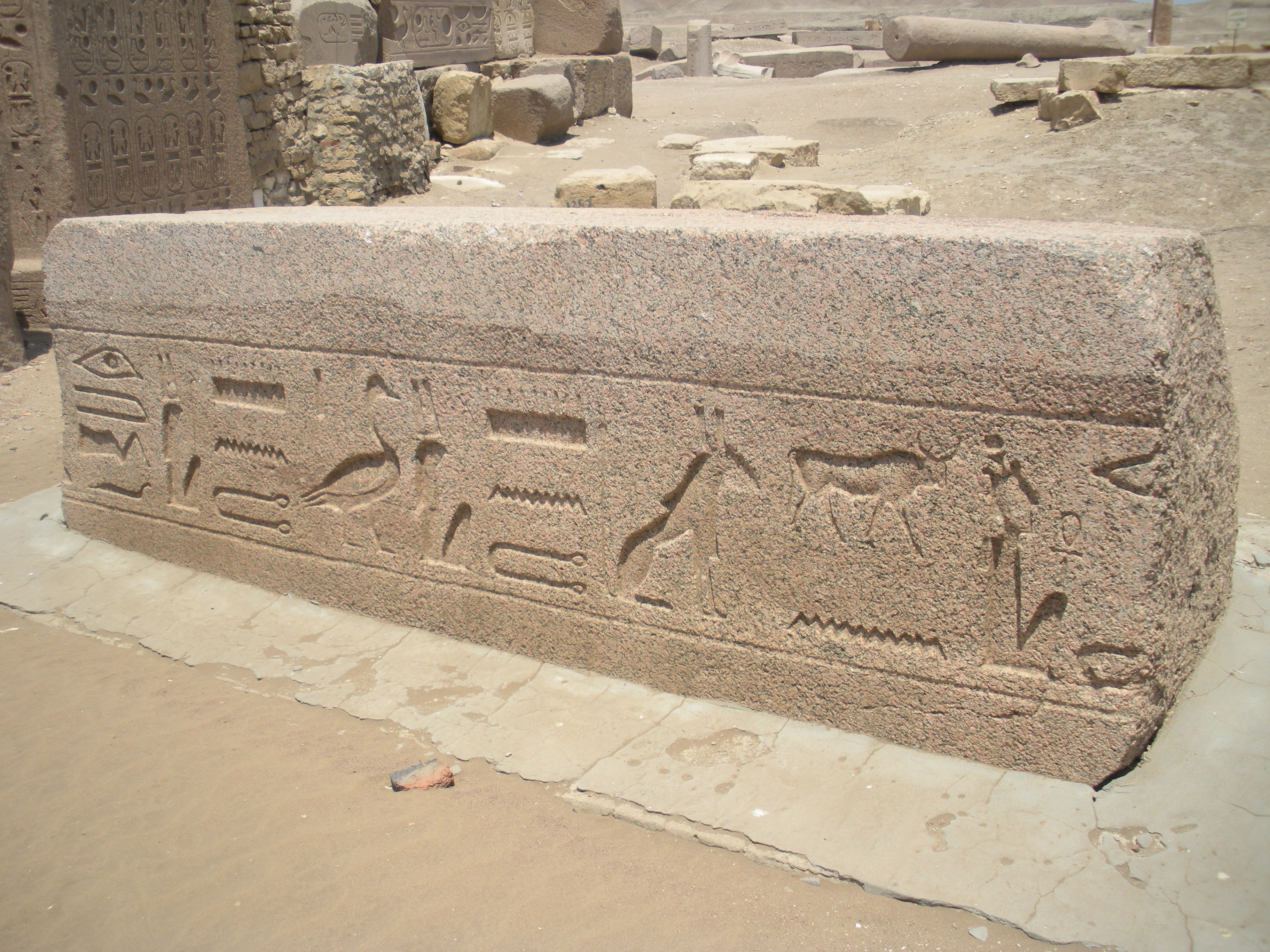
In context, this is Seti I or Seti II's cartouche, as the angled line to the left is certain to be the 'meri' (beloved of) glyph.
|
The source article of this image gives credit info, but because it was written for the paper magazine version, it does not correspond to the web version. Hence current location and past location and approximate date of creation are unknown. However, I did track down a a version at the BBC, which shows enough of the surrounding glyphs to reveal the Amun that is part of Seti II's name. The article's author, Patrick Houlihan, considers the Set animal 'monsterous' because he thinks it is a composite of one or more animals. Scholars vary on just what it was, a composite, or an animal now extinct:
"The Seth-animal has been connected with the ass, oryx, antelope, antelope,
greyhound, fennec, jerboa, camel, okapi, long-snouted mouse,
aardvark or orycteropus, giraffe and a kind of hog or boar. A. S.
Jensen 2) drew attention to the fact that it has also been regarded
as a hare, jackal, tapir, long-snouted mormyr of the Nile or the nh
bird of the Egyptians." TeVelde, _Seth, God of Confusion_, page 13
I've also read suggestions that the now extinct "Sivatherium (the name of which comes from the Hindu god Siva or Shiva, who shares some characteristics with Seth), which is a possible ancestor of the giraffe and okapi, and had strange "horns" or "antlers"" is a possible candidate:
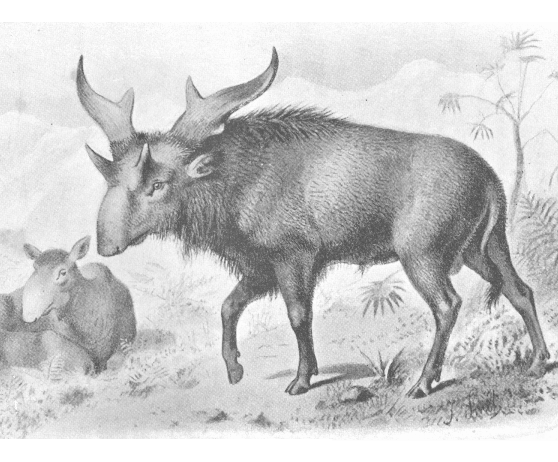 (Originally found at Copyrightexpired.com/)
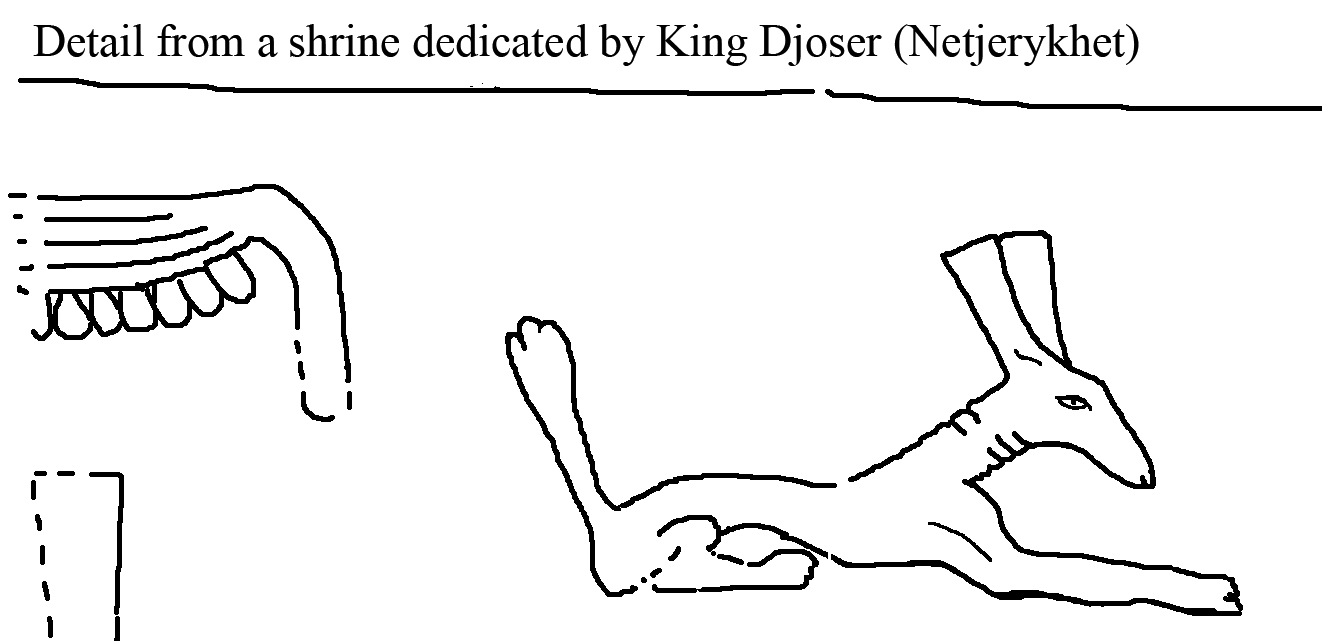
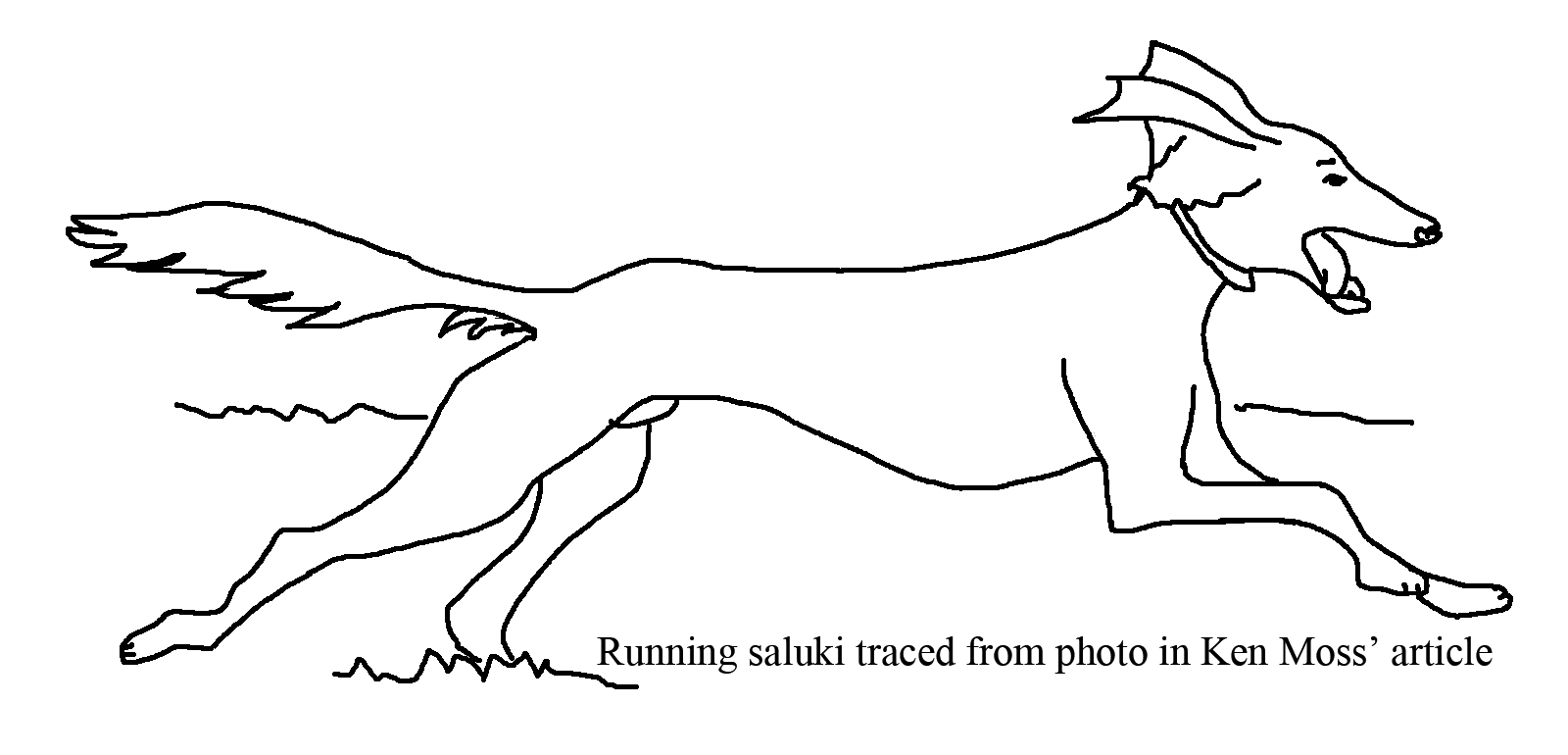
I've alternated in opinion between a greyhound type animal made to go extinct and a composite animal rather like the Griffin. The ancients might have come to the conclusion Set's personality is way too vast for just one animal to symbolize him. However, Ken Moss advances the idea that the Saluki is the prototype for the Set animal in the August/September 2009 issue of _Ancient Egypt_. "These oldest representations of the Seth-animal are clearly of a dog, but with two unique features: an erect tail and erect squared-off ears. The body of the Seth-animal has in fact always been that of a canine, with paws, and even the head was dog-like in the beginning. It was only over time that the head became exaggerated with a long, narrow, down-turned snout." (Page 43) Moss continues, "No animal has ever had ears that naturally ended in squared tips, but it was precisely this characteristic that led to my fortuitous discovery of the real Seth-animal. "While researching the god Seth, I happened upon a National Geographic program called The Hunting Hounds of Arabia, and there on the screen was a living Seth-animal. It was a streamlined dog with erect feathered tail and erect square-tipped ears running in the desert scrub after a desperate rabbit. The answer to the square-tipped ears was explained by the narrator. The dogs’ ears were cropped, that is the tips of the ears had been cut off by their owners. This is a long-standing tradition, still carried out in Syria and elsewhere, that is done in the belief it helps the dogs avoid being snagged on branches while pursuing their game. The breed is the magnificent Saluki, the quintessential Arabian hound of the Bedouin and others." (Page 43) Why are the Set-animal's ear's straight up? Observations of Salukis reveal that when they are running, the ears fly up, as does its tail. "The erect status of both the tail and ears of the Seth-animal is also now clear. The animal was portrayed in its hunting state rather than while resting like most dogs or canine deities (Anubis, for example, who was a dog said by some to have been fathered by Seth). This fits perfectly with the god Seth himself, the all-powerful god of action, a hunter and perpetual dispatcher of the serpent Apep [Apophis]. Abu Nuwas, a ninth century Arab poet, wrote of a hunting Saluki: 'Like an arrow it was sent, tearing away from his own skin, lightning like a cloud.'" (Page 44)
 Photo from Moss' article
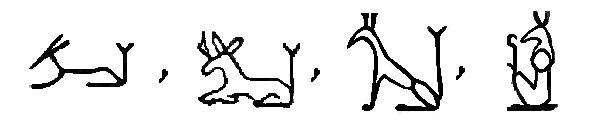 Source: TeVelde, _Seth, God of Confusion_
 Originally at Heliopolis, now at Egyptian Museum, Turin.
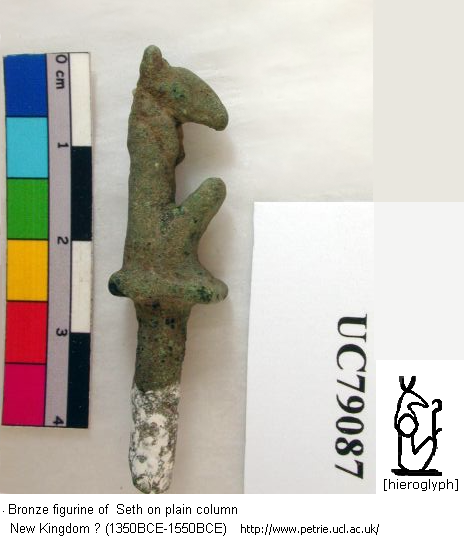 Bronze figurine of Seth on plain column Period - New Kingdom ? (1350BCE-1550BCE) Petrie Museum UC79087
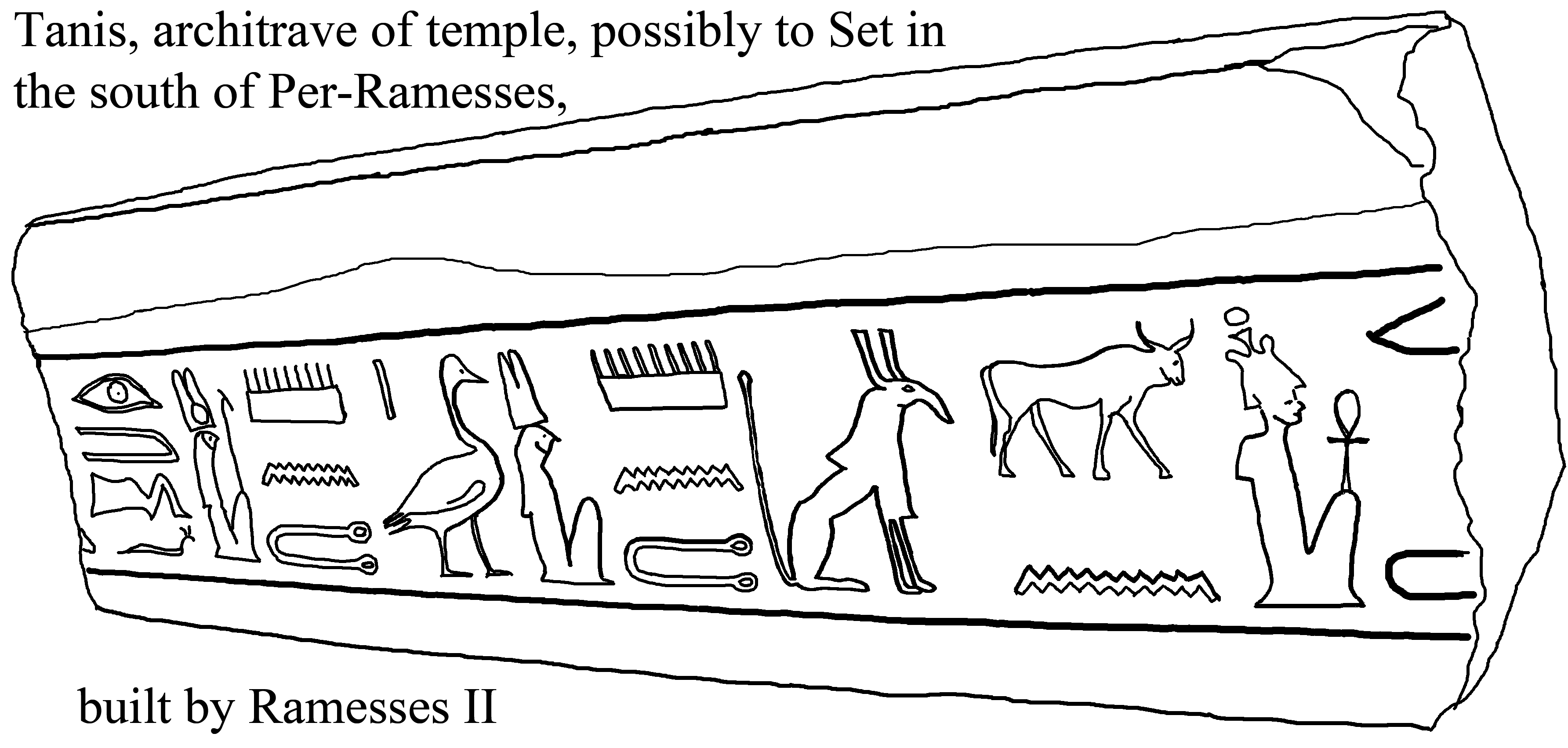 My trace of this piece
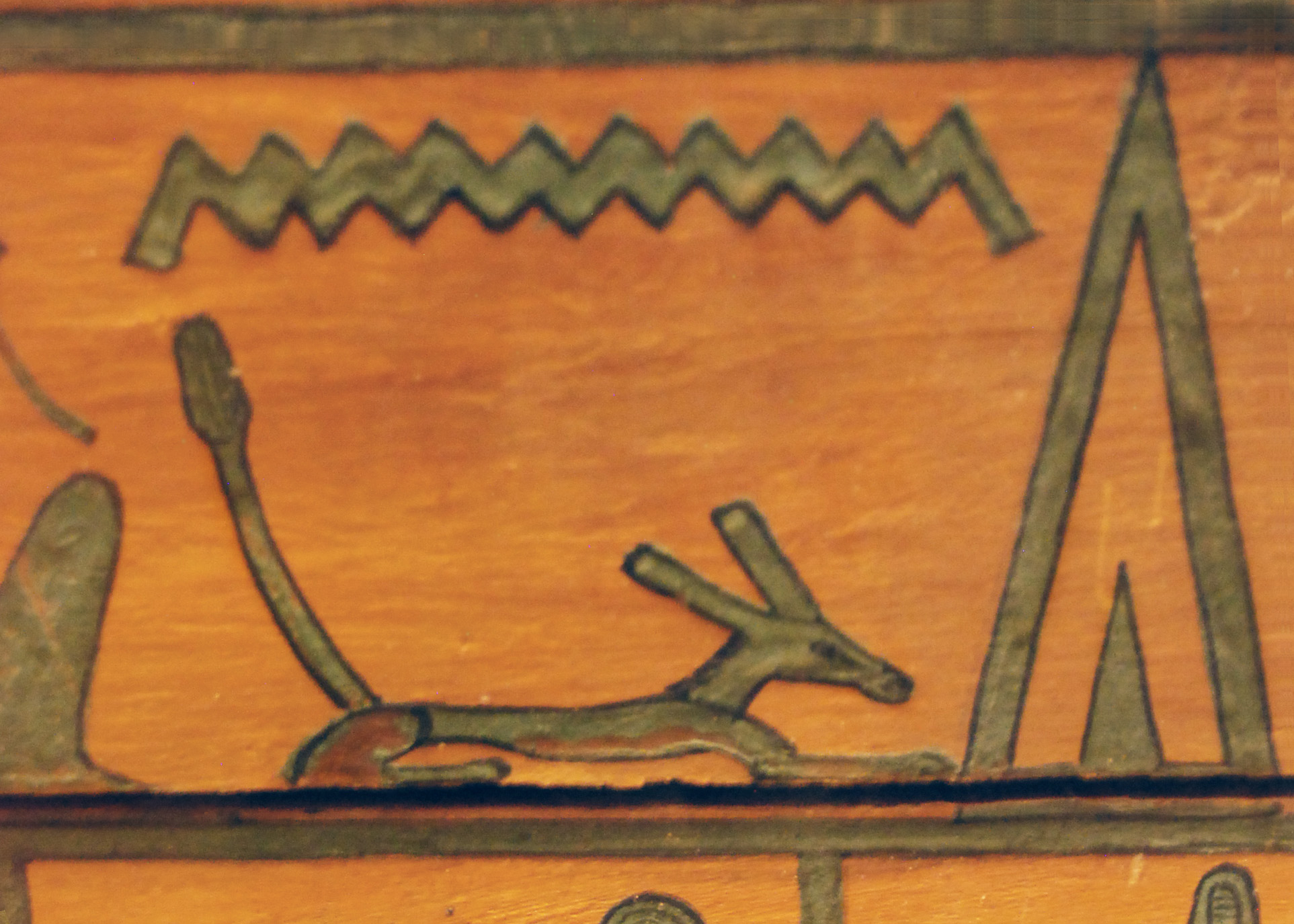
This Set animal appears on Henen's coffin, which is at the Louvre: |
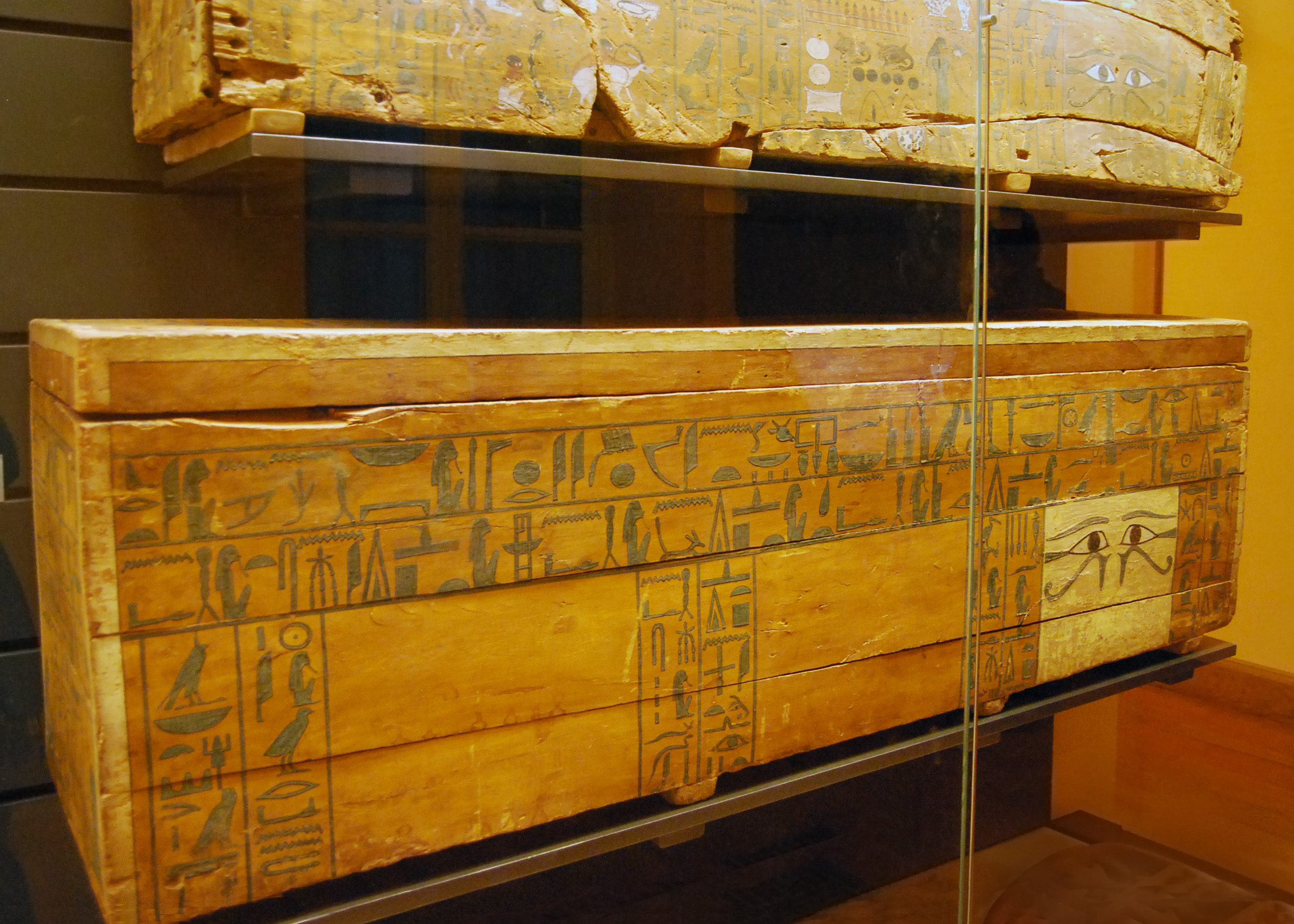
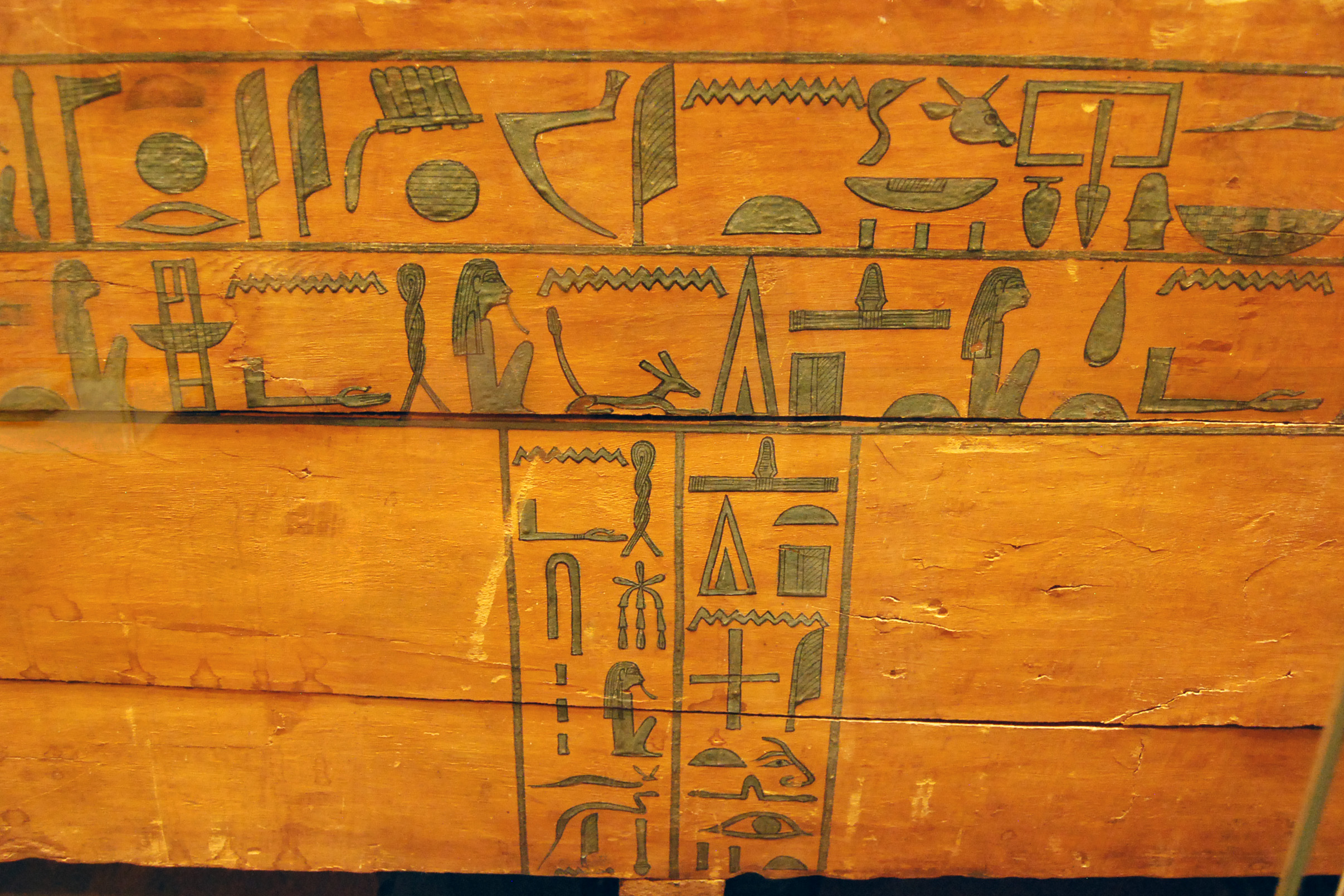
(Photos by Heidi Kontkanon)
| Looking up further information about this piece did not turn up very much. I only found this reference: |
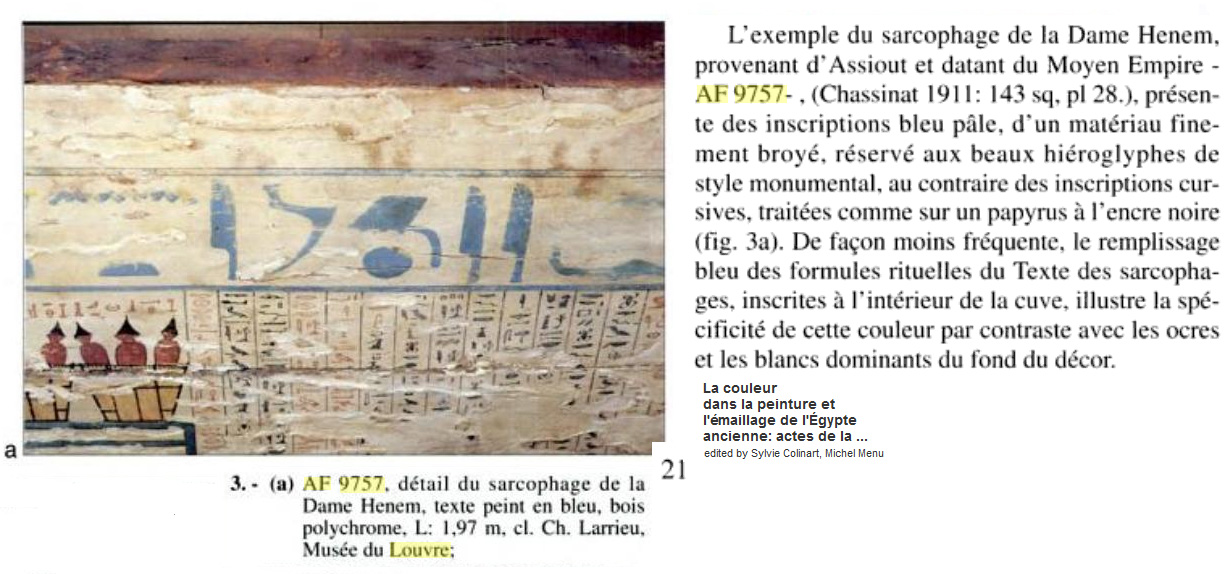 "L'exemple du sarcophage de la Dame Henem, provenant d'Assiout et datant du Moyen Empire - AF 9757..." "The example of the sarcophagus of Lady Henem, coming from Assiout and dating from the Middle Kingdom - AF 9757..." La Couleur dans la Peinture et l'Émaillage de l'Égypte Ancienne, by Sylvie Colinart, Michel Menu, page 21 |
|
"Henem", rather than "Henen", but the center portion of the glyphs in the example photo, which must come from the interior of the coffin, ("inscrites à l'intérieur de la cuve"), match those on the side panel. At least we know it's from the Middle Kingdom. What can we find out by examining the text itself? With my rudimentary hieroglyphic skills, I can detect several happy gods goddesses, (aka "contented" - "hotep"), having been given offerings. |
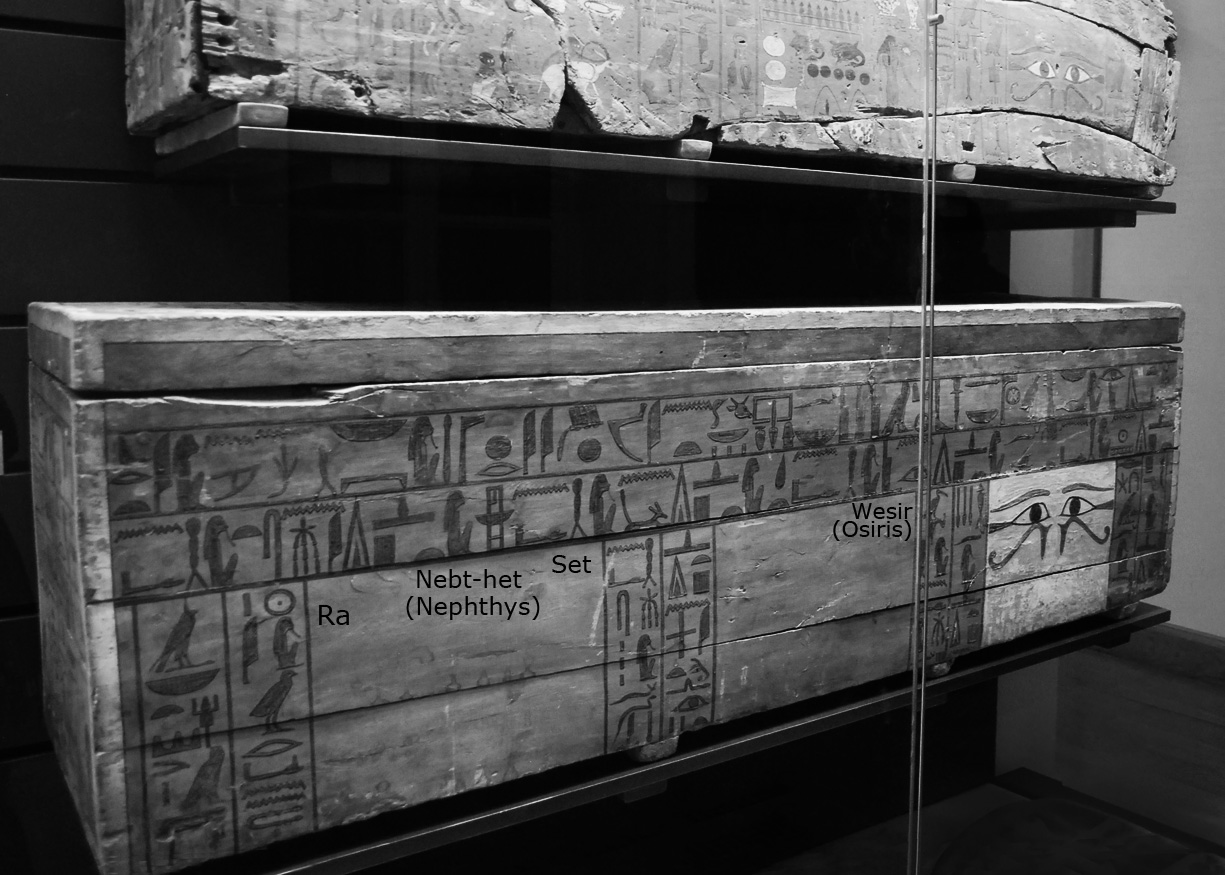
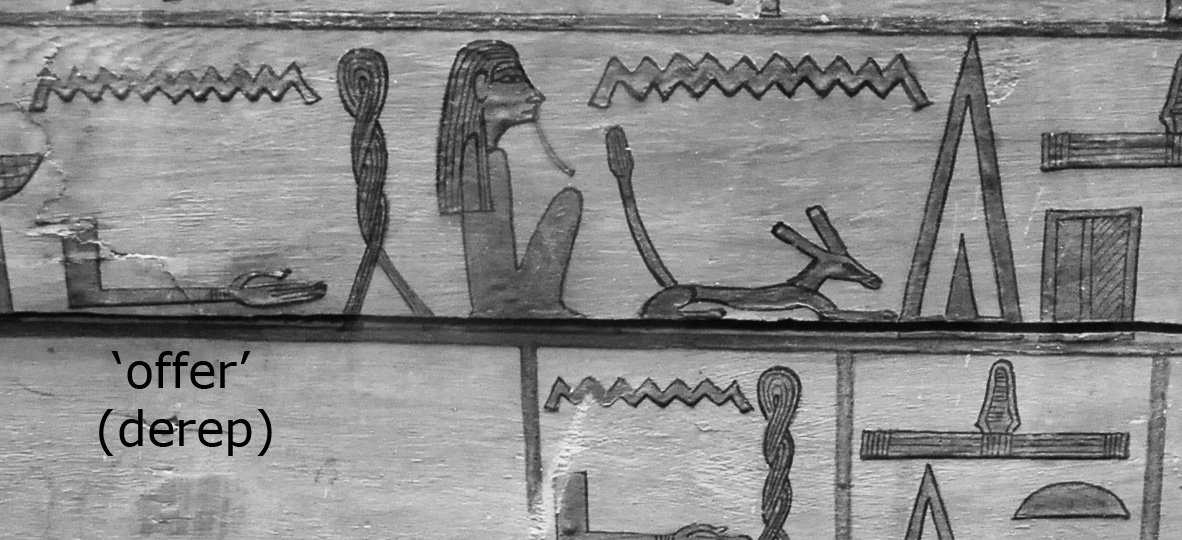
'Offer' (arm and hand extended), 'derep'


 And my trace....