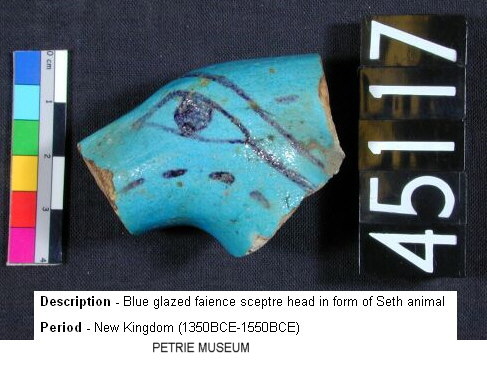
From Petrie Museum, University College, London, UC45117, New Kingdom, (1350BCE-1550BCE),
Blue glazed faience sceptre head in form of Seth animal
From Petrie Museum, University College, London, UC45117, New Kingdom, (1350BCE-1550BCE),
Blue glazed faience sceptre head in form of Seth animal
|
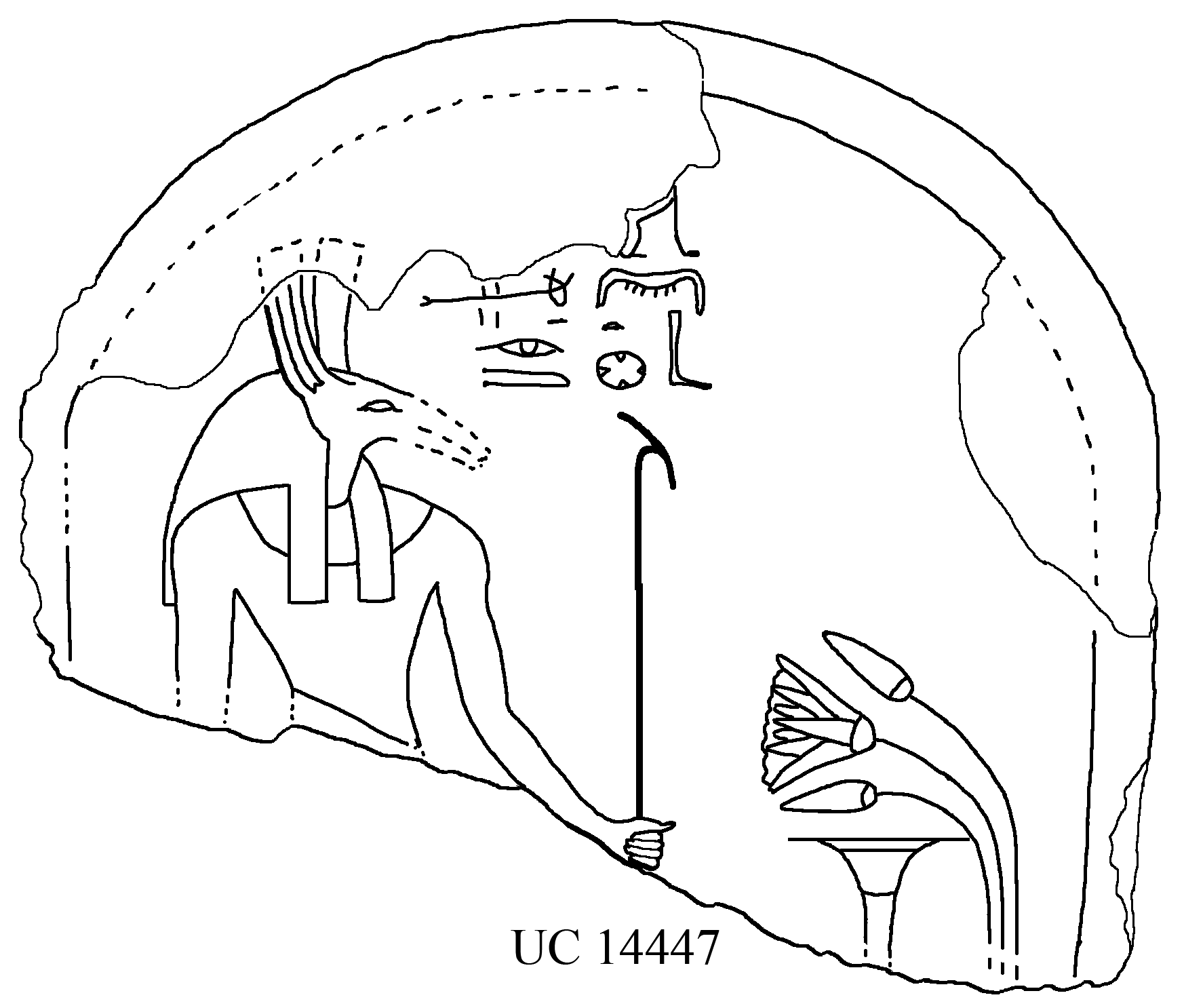
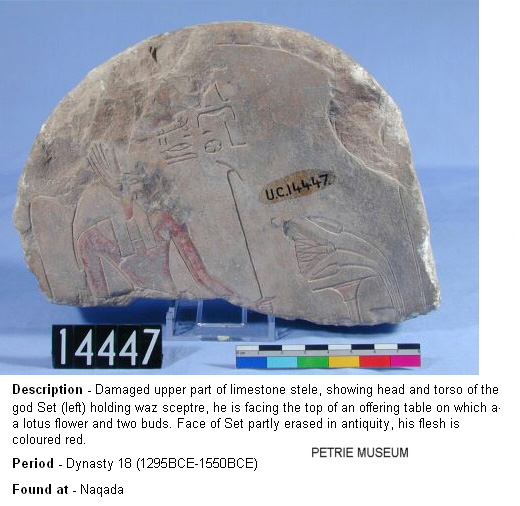
The above is only a fragment of a Was scepter, but it's particularily interesting because it so clearly shows Set's eye. Petrie found a rather damaged stela fragment at the Naqada temple: |
|
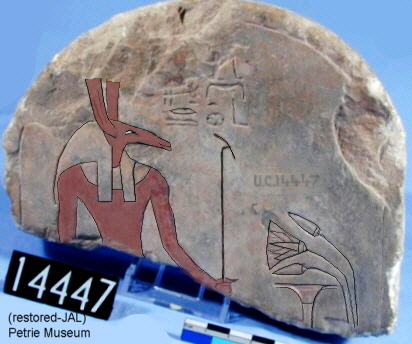
The Petrie Museum website describes UC 14447: “Damaged upper part of limestone stele, showing head and torso of the god Set holding Was sceptre. He is facing the top of an offering table on which rests a lotus flower and two buds. Face of Set partly erased in antiquity, his flesh is colored red. Found at Naqada, Dynasty 18.” I imagined this stela in a less damaged state, so I played with the image, and 'restored' it a bit: |
|
Here is a stela very similar to the one in the Petrie Museum. Petrie included a drawing of it in his _Naqada and Bellas_.
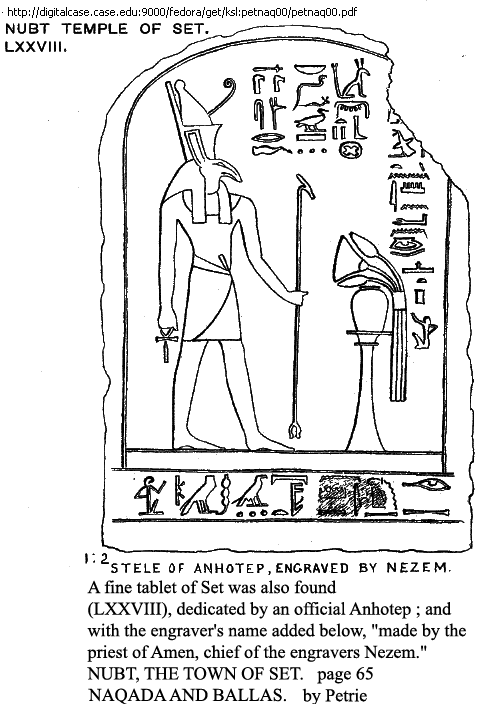 "A fine tablet of Set was also found (LXXVIII), dedicated by an official Anhotep; and with the engraver's name added below, "made by the priest of Amen, chief of the engravers Nezem."
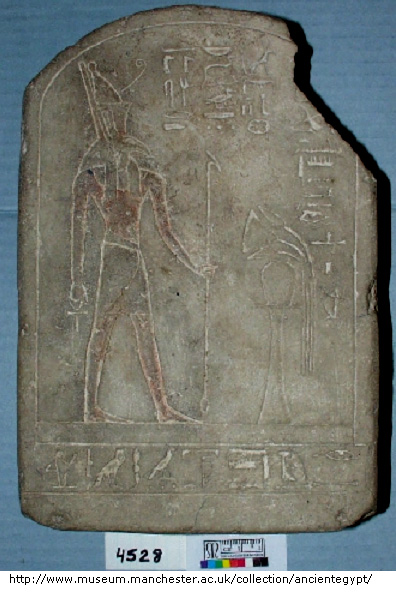 #4528, donation of Mr Jesse Haworth, 1895 Limestone, height 23.3cm, width 15.7cm
"In hieroglyphs, at top: Seth of Nebti, lord of provisions, great of strength, powerful of arm. In hieroglyphs, to right of altar: [word missing] of Amun, Anhotep. This is the title and name of the stela's donor. In hieroglyphs, at bottom: Made by the wab-priest of Amun, the chief of the craftsmen, Nedjem. This unusual inscription seems to name the man who made the stela, or who supervised the workshop where it was made." (info museum website) I believe I've matched up this Manchester museum description with the right photo:
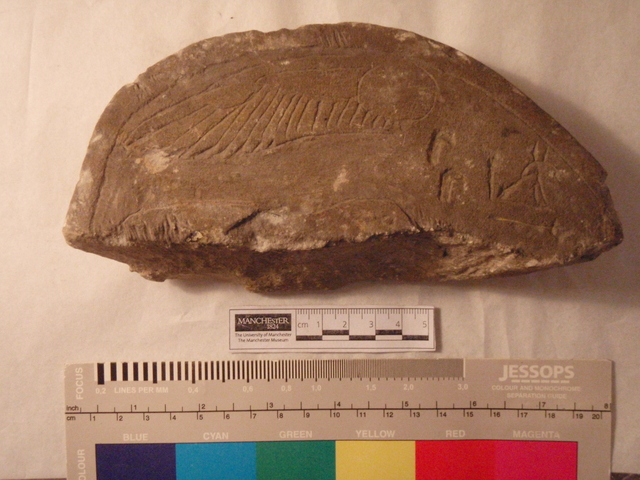 # 4565, Limestone "Fragment from the top of a round-topped, limestone stela, with the winged sun disc; inscribed for the god Seth." Inscriptions: "Fragment of hieroglyphic inscription incised at top right, for 'Seth, great of valour'" Height (cm) 9.4, Width (cm) 18.0
As I study the Petrie Museum website, I learn of Thutmose III. He built or rebuilt many temples in Egypt and Nubia as well. He did not ignore the temple of Seth and "enlarged or renovated the temple" for he left his name in the temple's foundation deposit: |
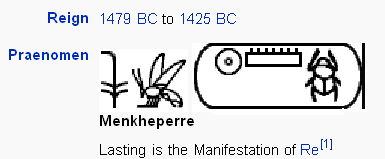
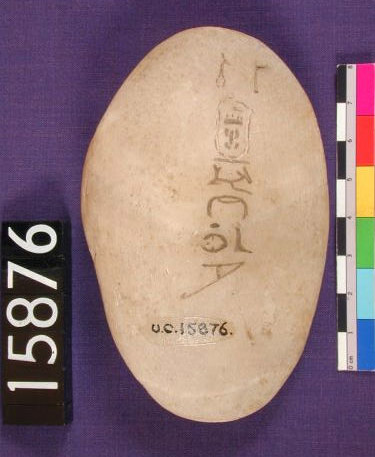
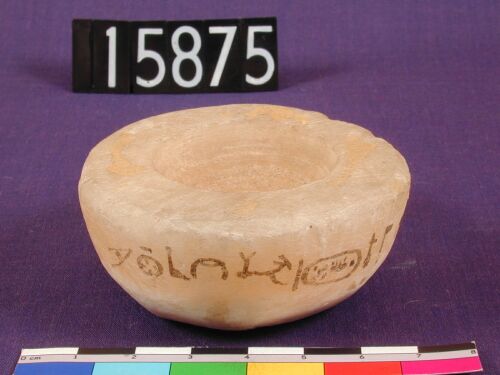
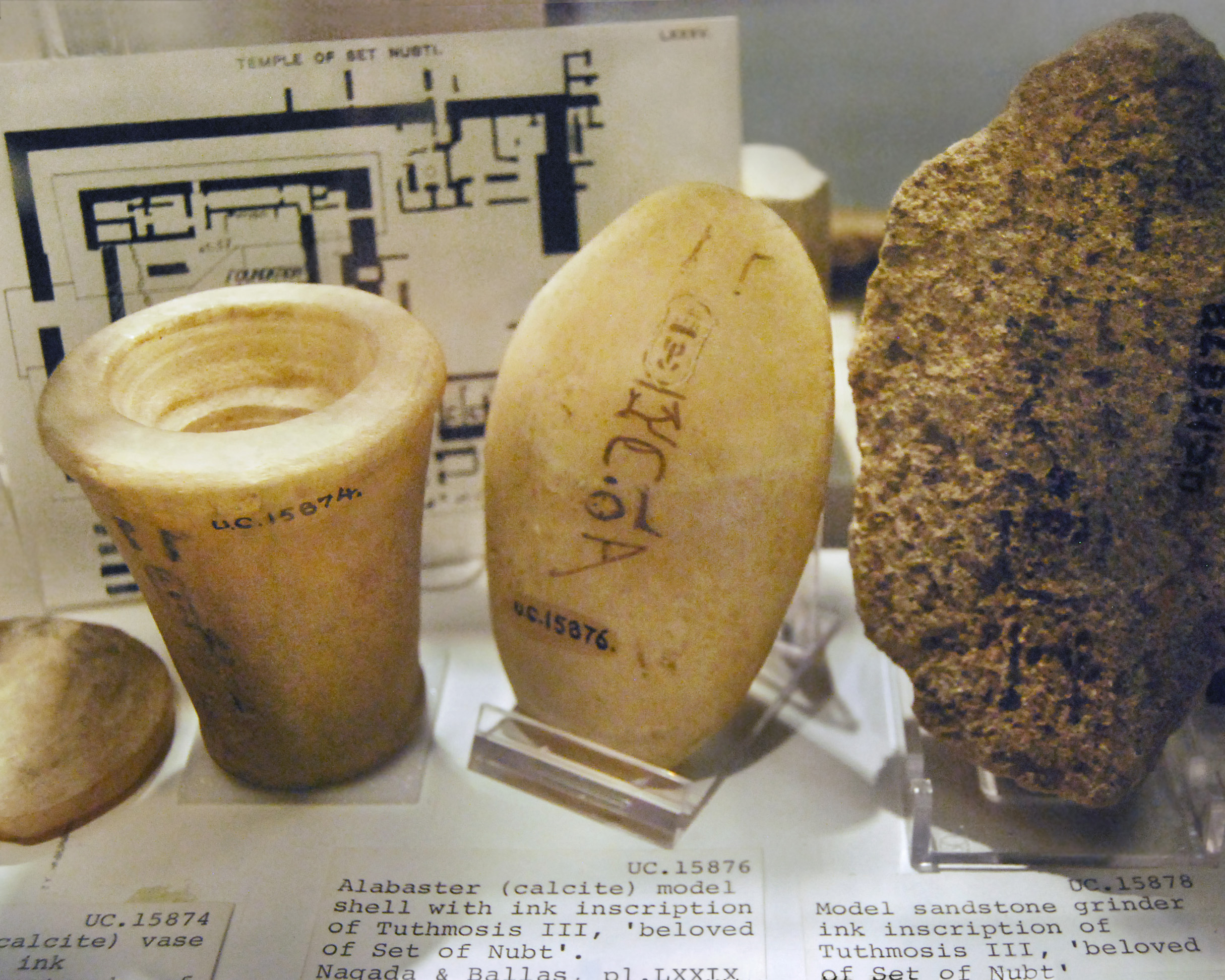
Heidi Kontkanon captured these pieces from Thutmose III's foundation deposit and shared the photo
Note the inscription translation: "Tuthmosis III, 'beloved of Set of Nubt'"
We can see part of Petrie's map of the Naqada temple
| Here is yet another stela fragment which may have come from Naqada: |
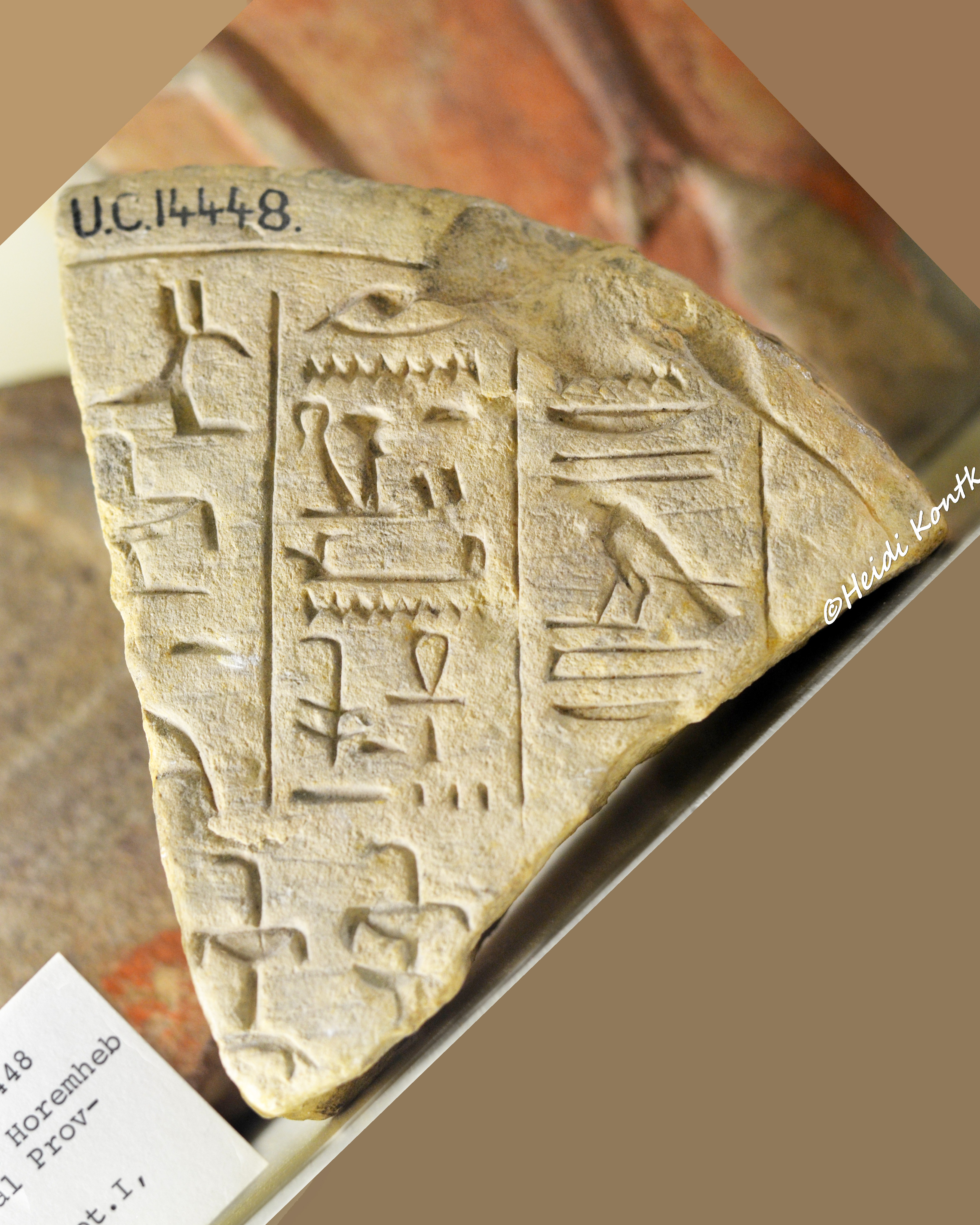
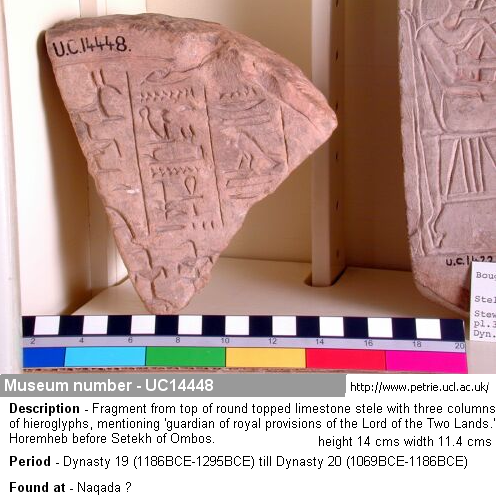 Fragment from top of round topped limestone stele with three columns of hieroglyphs, mentioning 'guardian of royal provisions of the Lord of the Two Lands,' Horemheb before Setekh of Ombos. Dynasty 19 (1186BCE-1295BCE) till Dynasty 20 (1069BCE-1186BCE), height 14 cms width 11.4 cms height 14 cms width 11.4 cms Petrie Museum UC14448
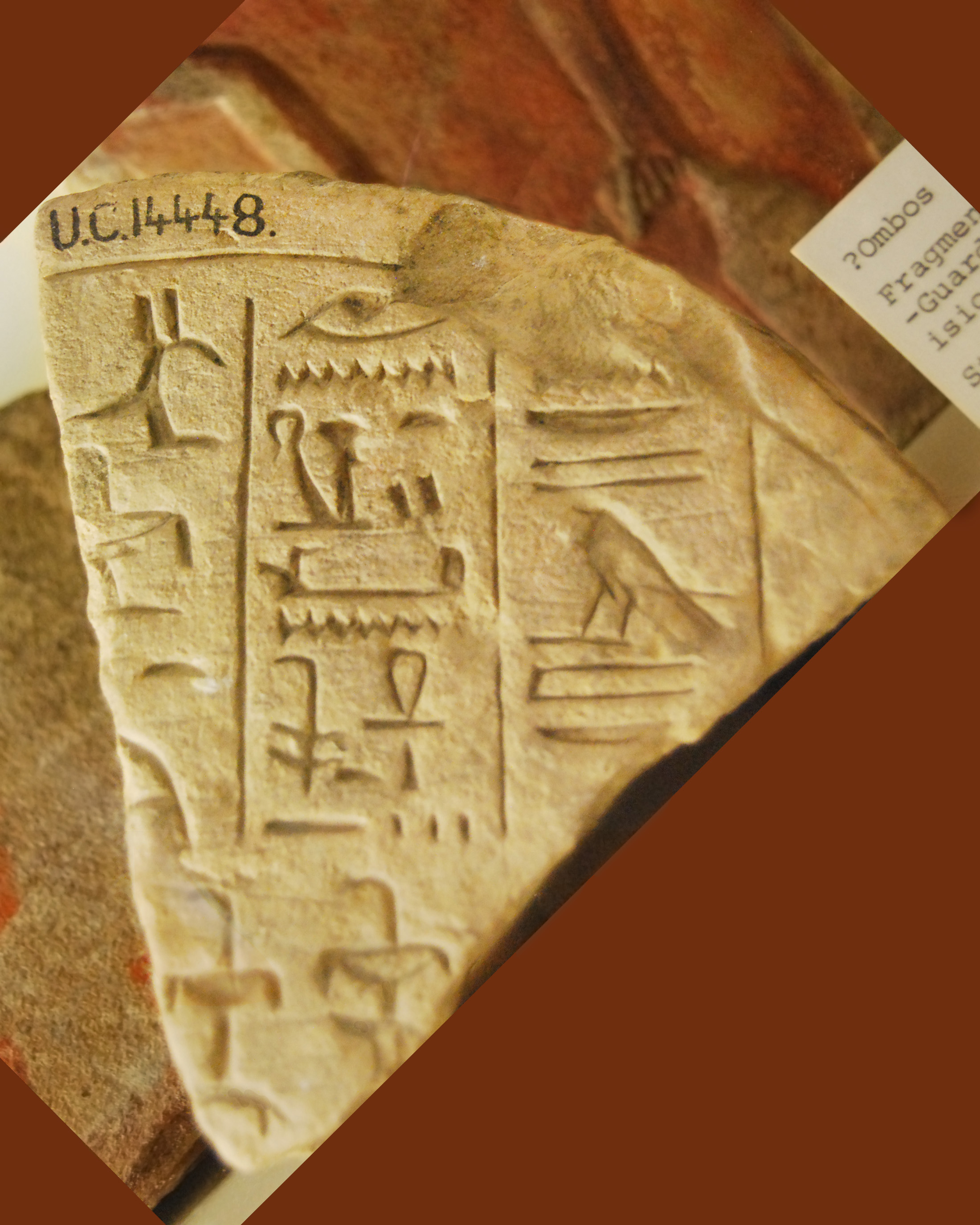 We can see its details better via this photo Heidi Kontkanon (which I rotated so it is upright).
|
|
I'm not sure why they are giving Dynasty 19 through Dynasty 20 for this fragment's date, when Horemheb was the last ruler of the 18th Dynasty. Possibly, his descendents were honoring him much later? Meanwhile, let's turn to a piece certain to be from the 19th Dynasty. Seti I expanded the temple of Set at Avaris, which Horemheb had built. Avaris later became "the new Delta residence of the Ramessid rulers" (_The Oxford History of Ancient Egypt_, edited by Ian Shaw, page 295) |
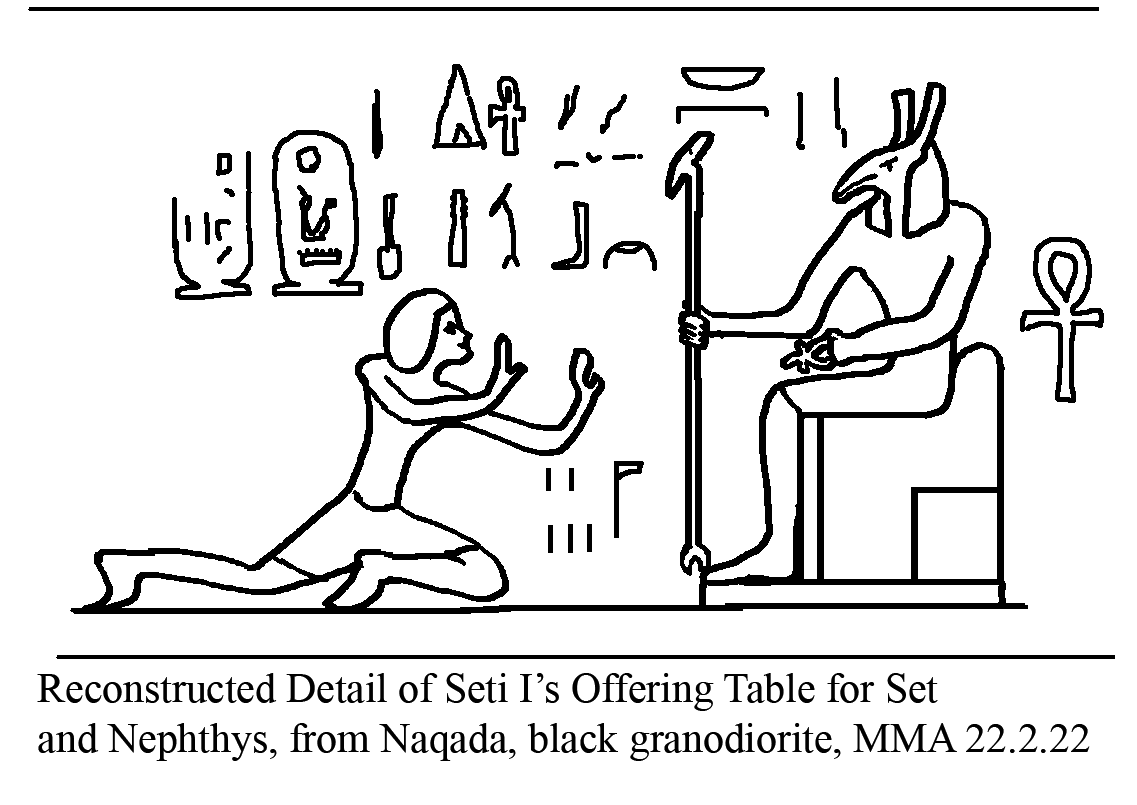
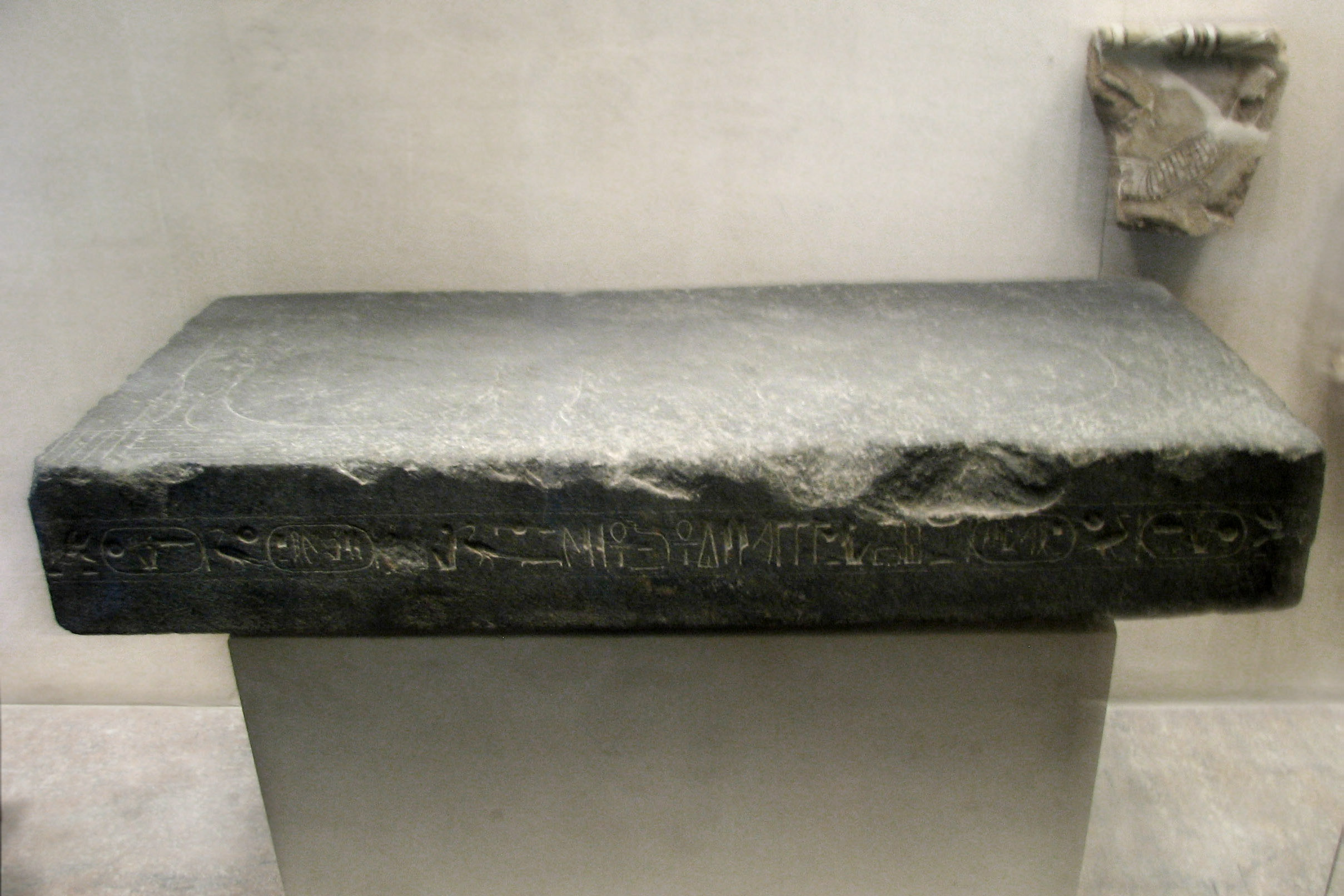 Offering Table of Seti I New Kingdom, Ramesside, Dynasty 19, reign of Seti I, ca. 1294–1279 B.C.E. Black granite, L. 105 cm (41 5/16 in). w. 53.3 cm (21 in), Thick. 15.8 cm (6 1/4 in) Rogers Fund, 1922, Metropolitan Museum 22.2.22 |
|
Peter Brand speaks of this offering table in his _Monuments of Seti I_:
"The layout of the decoration is identical to that of the Ny-Carlsberg table
dedicated to Horus, the table top being decorated with two pairs each of
conical and round bread loaves and a pair of jars. On the front side, two
miniature offering scenes flank the concave depression. On the right, Seti
kneels with his legs splayed out and his arms upraised in adoration of Seth,
who sits enthroned on a plinth. The act of the king is labeled "adoring the
god four times.' Seth's figure has been hacked out in antiquity, but its
outline, as well as many internal details, can easily be made out." (page 189)
The front of the table with its damage was to the back when I photographed it. But here is a close up detail of Seti I adoring Set, no doubt acting as High Priest of Set:
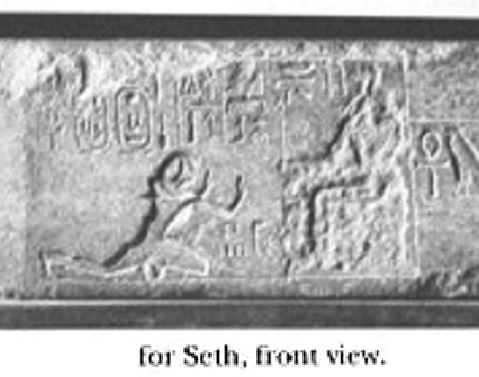 From a photo in Brand's book
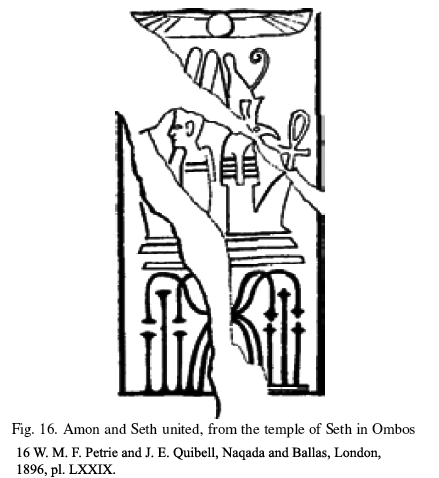 "Amun and Seth united, from the Temple of Seth in Ombos" 16 W. M. F. Petrie and J. E. Quibell, Naqada and Ballas, London,1896, pl. LXXIX.
|
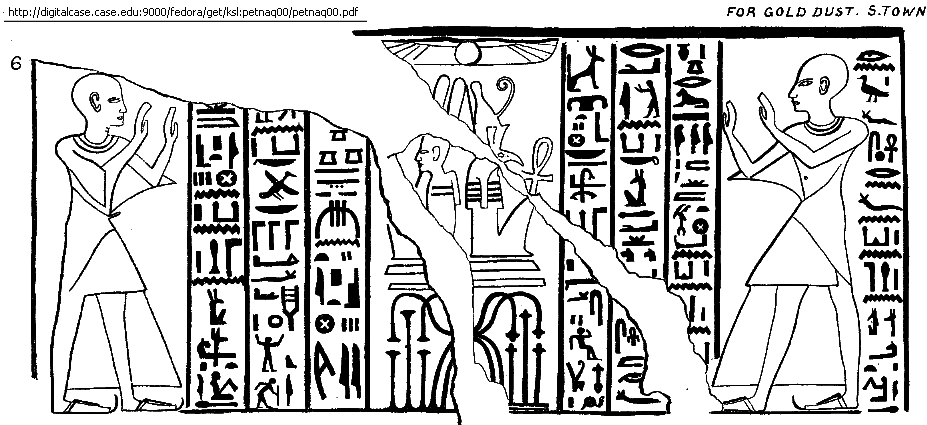
"Under Ramessu III some reconstructions went on, and a priest Userhat made new lintels to doorways of the chambers in the N.E. corner of the temenos. One lintel of his (pl. LXXIX) shews Set and Amen seated back to back over the intertwined Nile plants. On the left side Userhat is "Beloved of [Amen lord] of the thrones of the two lands who is in Karnak. [Giving praise] to thy ka, Oh Lord of the gods, that he may grant long life and a good old age . . . in Karnak to the ka of the prophet of Set, Userhat, makheru." On the right side is, "Set Nubti lord of the South land, great god, lord of heaven, fair child of Ra. Giving praise to thy ka, Set, the very valorous, [that he may give]. . . in Thebes to the ka of the prophet of Set, Userhat." And behind the figure is, "made by his son, who makes his name to live, for the ka of the prophet of Set, Userhat." (_Naqada and Bellas_, Petrie, page 70) |
| Here's another piece likely to be from the Naqada temple: |
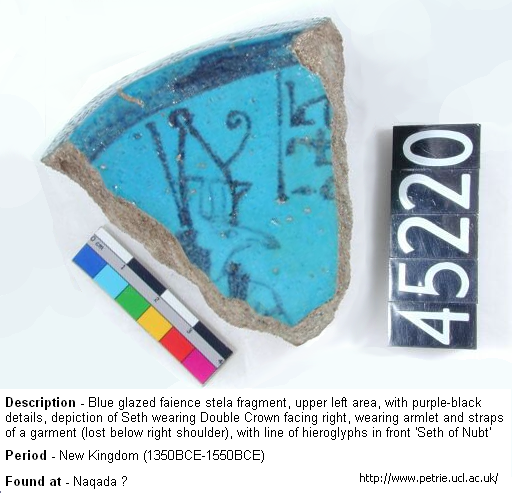 Period - New Kingdom (1350BCE-1550BCE) Found at - Naqada ? Petrie Museum UC45220
"Blue glazed faience stela fragment, upper left area, with purple-black details, depiction of Seth wearing Double Crown facing right, wearing armlet and straps of a garment (lost below right shoulder), with line of hieroglyphs in front 'Seth of Nubt'"
|
|
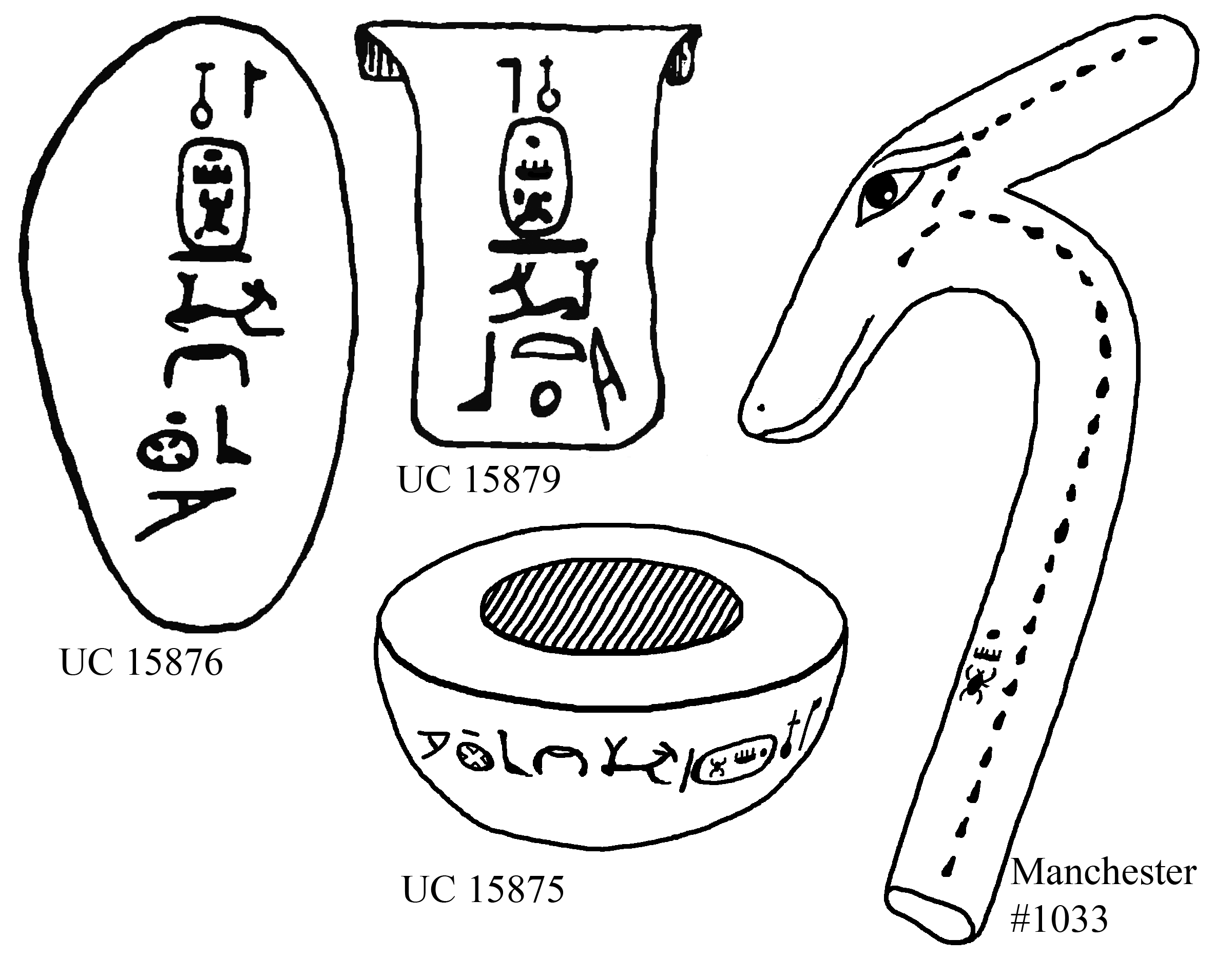
Not only that, we have a photo of another Was scepter which came from the Naqada area, and most likely from the Temple of Set there:
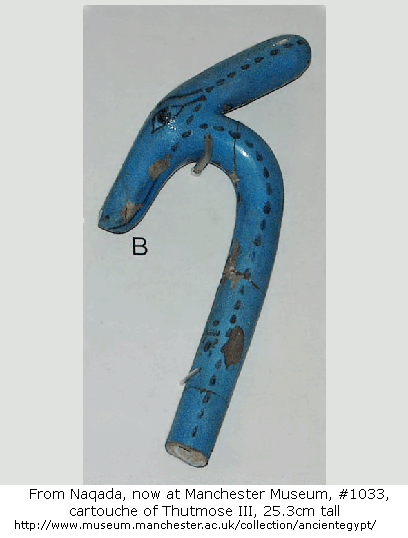 Manchester Museum, #1033 Faience with black decoration, 25.3cm high Dynasty 18, cartouche of Thutmose III Donation by Mr Jesse Haworth, 1895-1896
|
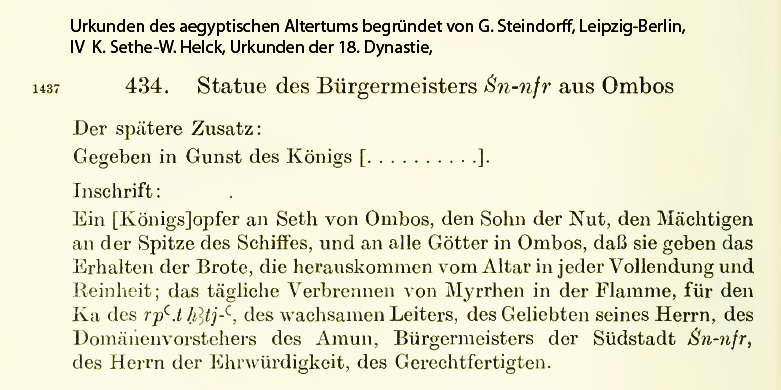
Statue of Sennefer, the mayor of Thebes, found at Naqada Temple
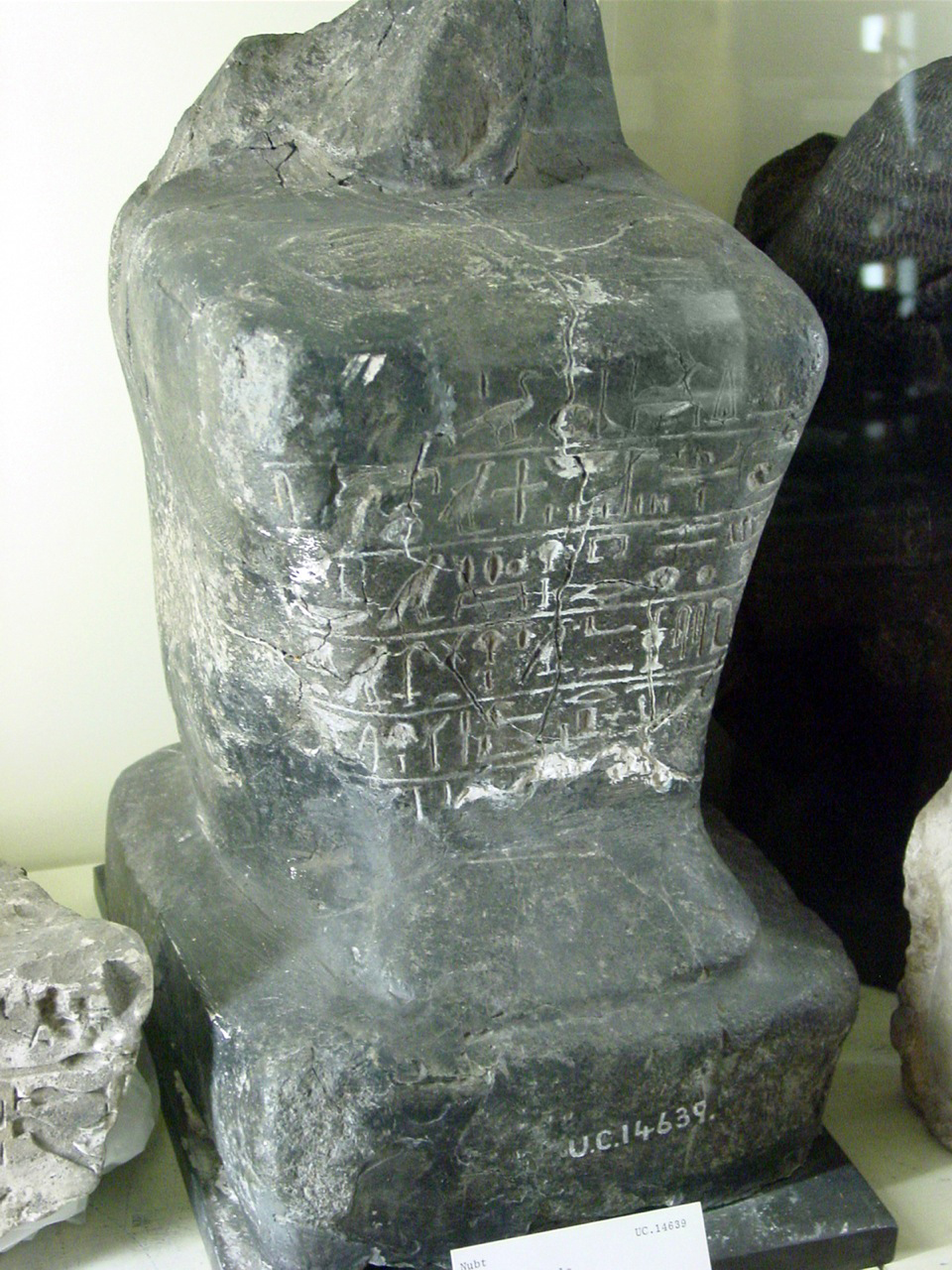
Statue of Sennefer, the mayor of Thebes, found at Naqada Temple, Petrie Museum UC 14639
Photographer "Tutincommon"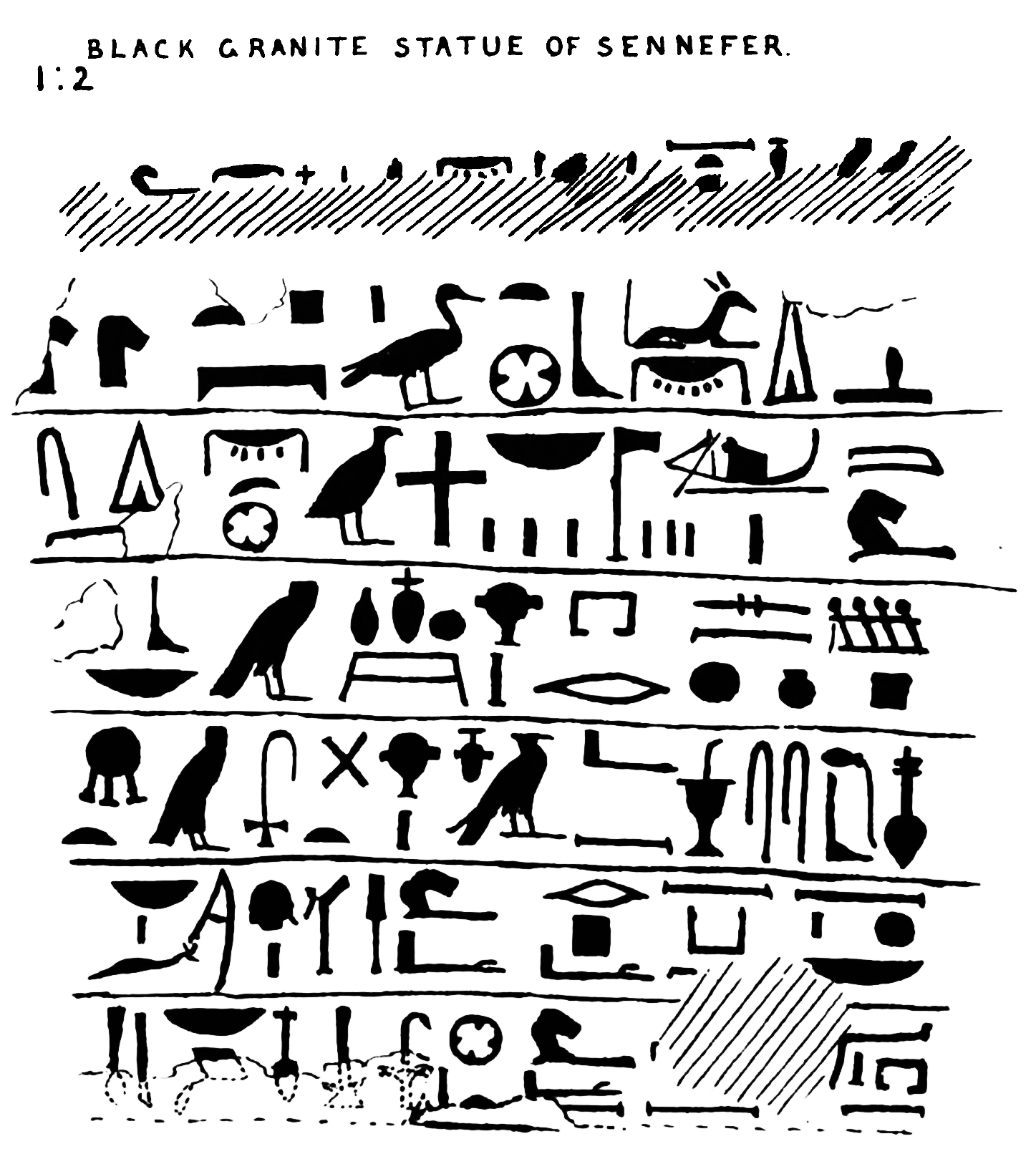
Image from Petrie
|
Hieroglyphs translated: "Given as a reward from the king in the temple of Nubti to the prince of the southern city Sen-nefer," and below, "May the king give an offering and Set of Nubit, son of Nut, very valorous, at the front of the sacred bark; and all the gods who are in Nubt, may they grant the receiving of food that appears upon the altar, of every good and pure thing, the offering of frankincense on the censer daily, to the Ka of the hereditary prince, the watchful overseer, who loves his lord, the steward of . . . prince of the southern city Sen-nefer, devoted to his lord, makheru." Naqada and Ballas by Petrie Makheru, aka Maa-kheru means 'true of voice', KA refers to an aspect of the immortal soul
Don't forget Thutmose I's lintel from this temple and the the HUGE 7ft. tall Was scepter found at the temple. |